Your Monstera Leaves Aren't Splitting Because of Light, Not Age
Quick answer
Monstera leaves don't split primarily because of age — they split in response to sufficient light. A plant that's old enough but poorly lit will keep producing solid, uncut leaves indefinitely. Improving light levels, ideally to 400–800 lux or more of indirect brightness, is the most reliable way to trigger fenestration.
If you’ve been waiting patiently for your monstera to grow up and start producing those dramatic split leaves, and nothing is happening — it’s worth reconsidering whether age is actually the issue. A lot of plants sit in low-light corners for years, putting out leaf after solid, uncut leaf, and the usual explanation is “give it time.” That explanation isn’t wrong exactly, but it’s incomplete in a way that keeps people waiting indefinitely for something that isn’t coming without a change.
The real driver behind fenestration — the splits and holes that make a monstera look like a monstera — is light. Age matters, but mostly because older plants have had more time to climb toward a light source. Take away the light and the age stops mattering much.
What Fenestration Actually Is (and Why the Plant Does It)
Here’s the part that makes it all click: those splits aren’t decorative. They’re functional.
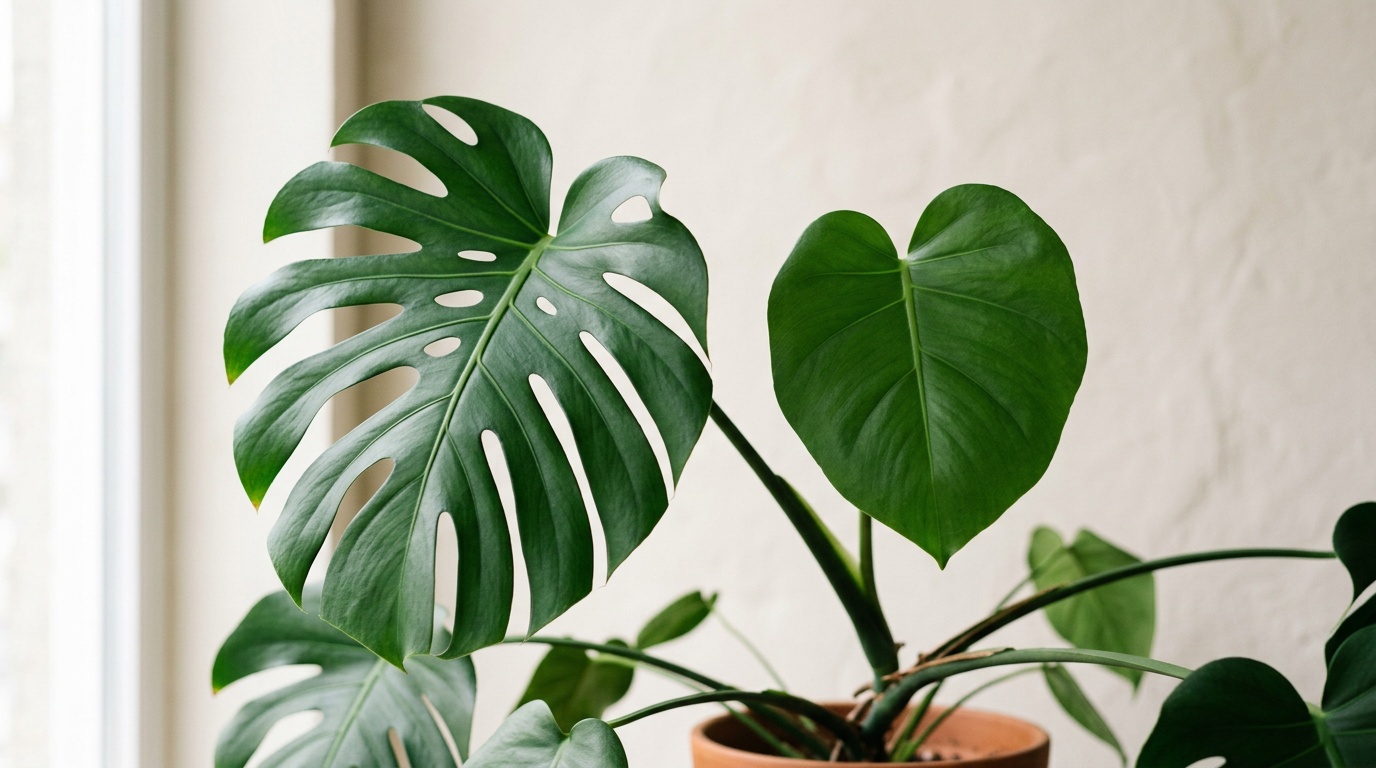
In the wild, monstera deliciosa grows on the jungle floor and climbs up trees toward the canopy. The leaves get enormous. A solid leaf that big would catch wind like a sail and tear, or it would shade out everything below it and block the lower portions of the plant from getting any light at all. The splits and holes solve both problems. Wind passes through instead of ripping the leaf apart. And dappled light filters down through the gaps to reach older leaves lower on the plant.
So fenestration isn’t just a sign that a plant is mature — it’s a specific adaptation the plant makes when it’s getting enough light to justify producing large, complex leaves in the first place. The plant is essentially deciding: I have enough light here to grow big. I should also make these leaves efficient for this environment.
In a dim room, there’s no reason for the plant to make that call. It just keeps producing small, solid leaves — staying in what you might call a permanent juvenile state — because the light signal that triggers the shift never arrives.
The Tell-Tale Sign Your Monstera Is Light-Stressed
You don’t always need a light meter to figure this out (though honestly, a light meter is pretty useful — more on that in a second). There’s a simple thing to watch for.
If your monstera is producing new leaves that are smaller than older ones on the same plant, that’s a light stress signal. A healthy, well-lit monstera should produce leaves that get progressively larger over time. When new growth comes in smaller, or the same size with no increase, the plant is struggling to support bigger leaf production. It’s conserving.
That’s your sign to move it before you wait another six months hoping something changes.
The other thing to look at is the petiole length — that’s the stem between the main stalk and the leaf. In low light, monsteras will stretch those out, sometimes dramatically, in an attempt to reach more light. Long, floppy petioles on a leggy-looking plant usually means the same thing: not enough light.
How Much Light Does a Monstera Actually Need to Split?
“Bright indirect light” gets thrown around a lot in plant care, and it’s not very useful information on its own. Bright to one person is dim to another, and windows vary enormously by size, direction, and what’s outside them.
The range that tends to correlate with fenestration is roughly 400 to 800 foot-candles, which is about 4,000 to 8,000 lux. That’s genuinely bright indirect light — the kind you’d find a few feet from a large south- or east-facing window, or closer to a smaller one. It’s not the kind of light that’s just “not dark.”
If you want to know what your plant is actually getting, a light meter takes the guesswork out completely. I wrote about how much it changed the way I place plants in A $15 Light Meter Changed How I Place Every Plant in My House — it’s one of those tools that seems unnecessary until you use it once and can’t imagine not having it.
Direct afternoon sun on the leaves isn’t the goal and can cause bleaching or burns. But a bright spot near a window — especially morning sun from an east window — is usually great. The plant can handle some gentle direct rays. What it can’t handle is a corner of the room where the light never really reaches.
What to Do If Your Space Is Just Too Dark
Not every home has great natural light. That’s just reality. If your windows are small, north-facing, or blocked by trees or buildings, you may not be able to get a monstera to a good light level through placement alone.
This is where a grow light genuinely helps. I know some people feel like grow lights are overkill for houseplants, but after adding one I saw a real difference within a few weeks — not just in my monstera but in several other plants nearby. I wrote more about that experience in I Added a Grow Light. My Plants Changed in Three Weeks.
For a monstera specifically, you want something that provides decent coverage because the leaves get big. A full spectrum grow light works well — the bseah Full Spectrum Grow Light with Timer is a solid option that’s not expensive and has a built-in timer so you’re not trying to remember to turn it on and off. If you want something you can position more precisely over a single plant, the Yadoker Height-Adjustable Grow Light is nice because you can raise it as the plant grows.
A grow light doesn’t need to run all day. Six to eight hours in the range your plant needs is usually enough.
Juvenile vs. Mature Leaves: What You’re Actually Looking For
It helps to know what the progression looks like so you can tell whether your plant is actually moving in the right direction.
| Leaf Stage | What It Looks Like |
|---|---|
| Seedling / Very Young | Small, heart-shaped, completely solid, no splits |
| Juvenile | Larger, still mostly solid, may have slight scalloping at the edges |
| Transitional | Edges begin to cut in, small splits appear at the margins |
| Mature | Deep splits reaching toward the midrib, oval holes (fenestrations) within the leaf body |
Most monsteras bought from a garden center are already past the seedling stage and somewhere in the juvenile-to-transitional range. They’re not starting from zero. That means if yours is producing only solid leaves, it very likely has the developmental capacity to fenestrate — it’s just not getting the signal.
When you improve the light and the plant responds, you’ll usually see the change in the next few new leaves. The ones already on the plant won’t change — a solid leaf stays solid. But new growth will start showing increasing complexity, and that’s how you know it’s working.
A Few Other Things That Can Slow Fenestration Down
Light is the main lever, but a couple of other things are worth checking if you’ve improved lighting and still aren’t seeing progress after a few months.
Pot size. A monstera in a pot that’s too large can spend a lot of energy dealing with excess soil moisture rather than putting energy into new growth. I go into more detail about potting specifics in Monstera Care: What the Vague Guides Don’t Tell You, but the short version is: if you’ve recently upsized into a significantly larger pot, give it time to settle. Most plants like to have their roots reasonably snug.
Support. In the wild, monsteras climb. When a monstera has something to climb — a moss pole, for example — it tends to produce larger leaves more quickly than one that’s just flopping sideways on a table. Larger leaves are more likely to fenestrate. If yours doesn’t have any support and the vines are sprawling, adding a LveSunny 49” Bendable Moss Pole and training it upward can actually help push the plant toward more mature growth patterns.
Watering. Consistently overwatered monsteras are stressed monsteras, and a stressed plant is not going to put energy into producing fancy fenestrated leaves. A simple Fpxnb Soil Moisture Meter is one of the most useful things a beginner can have — you stick it in the soil and it tells you whether to water or wait. Most monsteras want to dry out at least partially between waterings. If the soil is staying soggy, that’s a problem worth fixing before worrying about anything else.
Fertilizing. This one’s lower on the list, but a monstera that’s been in the same soil for years with no feeding isn’t getting the nutrients it needs to produce big healthy leaves. A mild fertilizer, used regularly at half strength or so, keeps things moving. Nothing dramatic needed.
The Bottom Line on Getting Your Monstera to Split
If your monstera has been around for two or three years and isn’t producing split leaves, stop waiting and start troubleshooting. The answer is almost always light. Move it closer to a window, or add a grow light if your space can’t get it there naturally. Watch the new leaves that come in over the next couple of months — that’s where you’ll see the result.
It’s a satisfying thing when it finally happens. New leaves start coming in with those little edge cuts, then deeper slits, then actual holes. The plant that looked kind of plain for a long time suddenly starts looking like the dramatic tropical statement piece you were hoping for. It just needed the right conditions to get there.
Frequently asked questions
Why aren't my monstera leaves splitting?
The most common reason is insufficient light. Monstera fenestration — the splits and holes in mature leaves — is triggered by light exposure, not just age. A plant kept in a dim spot can go years without producing fenestrated leaves, even when it's old enough to do so. Moving it to a brighter location is usually the fix.
How old does a monstera need to be to split?
Most monsteras are capable of producing fenestrated leaves once they've been growing for around two to three years and have reached a certain leaf size — but age alone doesn't guarantee splits. Light is the bigger factor. A well-lit younger plant will often fenestrate before a dim older one.
Does light affect monstera fenestration?
Yes, significantly. Fenestration is widely understood to be a light-driven adaptation. In the wild, the splits allow lower leaves to catch light filtering through the canopy. In your home, a monstera in a bright spot is far more likely to produce split, holey leaves than one sitting in a corner away from windows.
How much light does a monstera need to produce split leaves?
Bright indirect light in the range of roughly 400–800 foot-candles (about 4,000–8,000 lux) seems to be the sweet spot for encouraging fenestration. Direct harsh afternoon sun isn't necessary — and can burn the leaves — but a dim room almost certainly won't get you there.