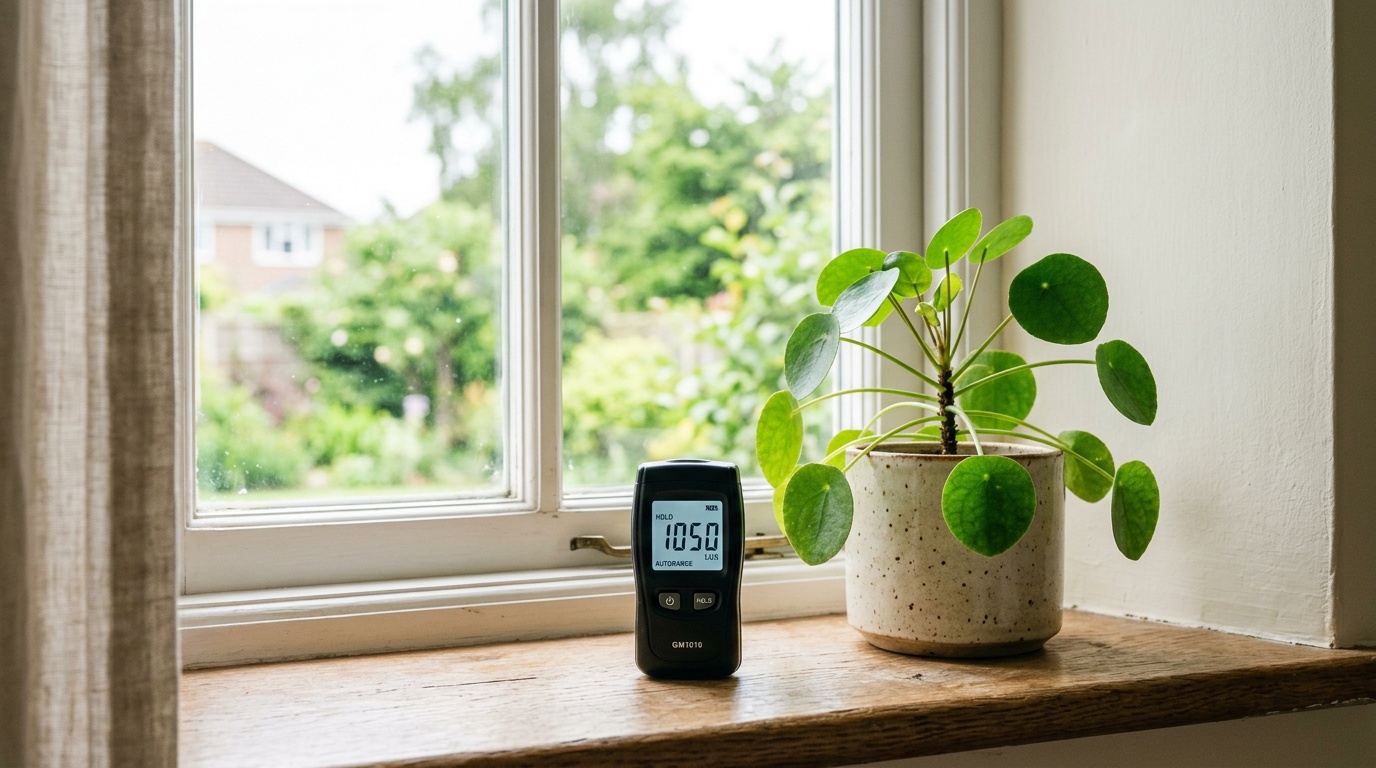
A $15 Light Meter Changed How I Place Every Plant in My House
Quick answer
A lux meter measures the actual light intensity your plants receive, in numbers your eyes can't perceive on their own. Human vision adapts too well to low light, making dim rooms look fine. A basic $15 meter lets you match each plant to a spot that actually fits its light needs.
Your Eyes Are Optimists. Your Plants Are Not.
Walk into almost any room in your house on a sunny afternoon and it probably looks pretty bright. Maybe there’s a window across the room, light bouncing off the walls, everything feels fine. So you put a plant there. A few months later it’s stretching sideways, dropping leaves, looking sad — and you can’t figure out why.
Here’s what’s happening: your eyes are adapting, constantly and automatically, to whatever light is available. It’s one of the things human vision does remarkably well. The problem is that your plants aren’t doing the same thing. They’re working with exactly the photons that reach them, nothing more. And in most indoor spaces, that’s a lot less than you think.
A lux meter doesn’t adapt. It just measures. That’s why picking one up — I paid around $15 for mine — genuinely changed how I think about every single spot in my house.
What a Lux Meter Actually Does
Lux is a unit of illuminance — basically, how much light is hitting a surface per square meter. A lux meter has a small sensor you hold out at plant level, and it gives you a number. That’s it. No interpretation, no adjustment for what looks comfortable to human eyes. Just the measurement.
Foot-candles are the other unit you’ll sometimes see, mostly in older American references. One foot-candle equals about 10.76 lux. Most modern plant care resources use lux, so that’s what I’ll stick with here.
The numbers that matter, roughly speaking:
| Light Level | Lux Range | Example Plants |
|---|---|---|
| Low light | 500–2,500 lux | Pothos, snake plant, ZZ plant |
| Medium light | 2,500–10,000 lux | Most tropical houseplants |
| High light | 10,000–20,000+ lux | Succulents, cacti, most fruiting plants |
| Full outdoor sun | 50,000–100,000+ lux | (for reference) |
Most living rooms with a decent window land somewhere between 500 and 3,000 lux depending on time of day, season, and how close you are to the glass. That “bright” spot across the room from your window? Probably 200–800 lux on a good day.
The Moment the Numbers Stop Surprising You (And Start Helping You)
When I first got my meter, I wandered around my house at noon on a clear day just taking readings. A few things stood out:
The spot right next to my south-facing window — within about a foot of the glass — was reading around 8,000–12,000 lux. Genuinely bright. My succulents belong there.
Three feet back from that same window: around 2,500 lux. Still decent. Fine for something like a pothos or a heartleaf philodendron.
The corner of my living room that I always thought of as “pretty bright because the whole room gets light”: 400 lux. That’s it. Barely enough for the most shade-tolerant plants on their best day.
I had a monstera sitting in that corner. No wonder it had slowed down to basically nothing. It wasn’t dying dramatically — it just wasn’t really living either.
This is the thing about low-light stress: it often doesn’t look like anything obvious at first. The plant just… stalls. Growth slows, new leaves come in smaller, the whole thing looks a bit tired. If you want to go deeper on what’s actually happening physiologically when a plant doesn’t get enough light, the post on what “bright indirect light” actually means covers that really well.
How to Use a Light Meter Practically
You don’t need to get obsessive about this. Here’s a simple approach that works:
Take readings at the same time each day. Midday is easiest because that’s usually peak intensity. The numbers will shift a lot through the day and across seasons, but midday gives you a consistent reference point.
Measure at leaf level, not eye level. Hold the sensor where your plant’s leaves actually are. Light drops off fast with distance, so this matters more than you’d think.
Check the same spot in different seasons. A spot that reads 5,000 lux in June might be down to 1,200 lux in December. This explains a lot of the “my plant was fine and then suddenly wasn’t” situations.
Look up your specific plant’s lux range. A quick search for ”[plant name] lux requirements” usually turns up a reasonable range. Use that to decide if the spot you’re measuring is actually a match.
Move the plant if the numbers don’t fit, and give it a few weeks. If a plant isn’t doing well and the lux reading is on the low end of what it needs, try a brighter spot. This is honestly my whole method — measure, move if needed, wait and see. It’s not complicated.
The Phone App Option: Good Enough to Be Revealing
If you want to try this before buying anything, there are free apps that use your phone’s camera sensor to estimate lux. Search “lux light meter” on iOS or Android and you’ll find several options.
They’re not as accurate as a dedicated meter — phone cameras are designed to compensate for low light so your photos look good, which is basically the opposite of what you want for an objective measurement. But even with that caveat, they’re eye-opening. When someone at work asks me about a struggling plant, the first thing I tell them is to download one of these apps and take a reading in the spot where the plant lives. The number is almost always lower than they expected.
If you find yourself actually using it and wanting more reliable readings, then it’s worth the $15 for a real meter. But starting with the app is a totally reasonable first step.
When the Numbers Are Just Too Low
Sometimes you take a reading and realize the spot you love — the one that looks great, fits your shelving, works with your layout — is just not going to work for the plants you want there. At that point you have two options: choose a different plant for that spot, or add light.
I’ve done both. For really dim corners, I’ve switched to plants that genuinely handle low light — ZZ plants, snake plants, cast iron plants. They’re not the most exciting, but they’re honest about what they need and they deliver.
For spots where I want a specific plant that needs more light than the window provides, I’ve added grow lights. It sounds like a bigger deal than it is, and honestly the results were faster than I expected — the full story of how my plants changed after I added a grow light is worth reading if you’re curious. A Yadoker Height-Adjustable Grow Light works really well for supplementing a spot that’s close but not quite bright enough, because you can dial in the height to get the intensity you need without frying anything.
One Tool, Genuinely Worth It
I’m not someone who thinks you need a lot of gadgets for plants. A soil moisture meter, yes — that one I recommend pretty often because overwatering is how most beginners lose plants. But beyond that, most things you can figure out by just paying attention.
A light meter is the exception. It gives you information you genuinely cannot get any other way. Your eyes will keep telling you a room looks bright. The meter tells you what your plants are actually working with. And once you have that number, you can actually do something about it — find the right spot, pick the right plant, or add light where it’s needed.
Fifteen dollars. Takes about ten seconds to get a reading. I use mine a few times a month, especially when I’m moving things around or when something isn’t doing as well as I’d expect.
If a plant is struggling and you can’t figure out why, measure the light first. It’s usually that.
Frequently asked questions
How do I measure light levels for houseplants?
Use a lux meter — a small handheld device that costs around $15 online. Hold it at the level of your plant's leaves and take a reading midday when light is strongest. That number tells you how much usable light your plant is actually receiving. A free phone app like Lux Light Meter can also give you a ballpark, though it's less precise than a dedicated meter.
What lux level do houseplants need?
It depends on the plant. Low-light plants like pothos or snake plants can manage on 500–2,500 lux. Medium-light plants — think most tropicals — do best around 2,500–10,000 lux. High-light plants like succulents and most fruiting plants want 10,000–20,000 lux or more. Most living rooms, even ones with nice windows, land somewhere in the lower range of that scale.
Is there a free app to measure plant light?
Yes — apps like Lux Light Meter (iOS and Android) use your phone's camera sensor to estimate lux. They're not as accurate as a dedicated meter because phone cameras are designed to compensate for low light, not measure it objectively. But they're still revealing. Most people are genuinely surprised by how low the numbers are, even with an imprecise reading.
Why can't I just judge plant light by eye?
Because your eyes are remarkably good at adjusting to low light — it's one of the things human vision does best. A room that feels comfortably bright to you might be measuring 300–500 lux, which is barely enough for the most shade-tolerant plants. Your plant has no such adaptation. It gets exactly the photons that are there, no more.