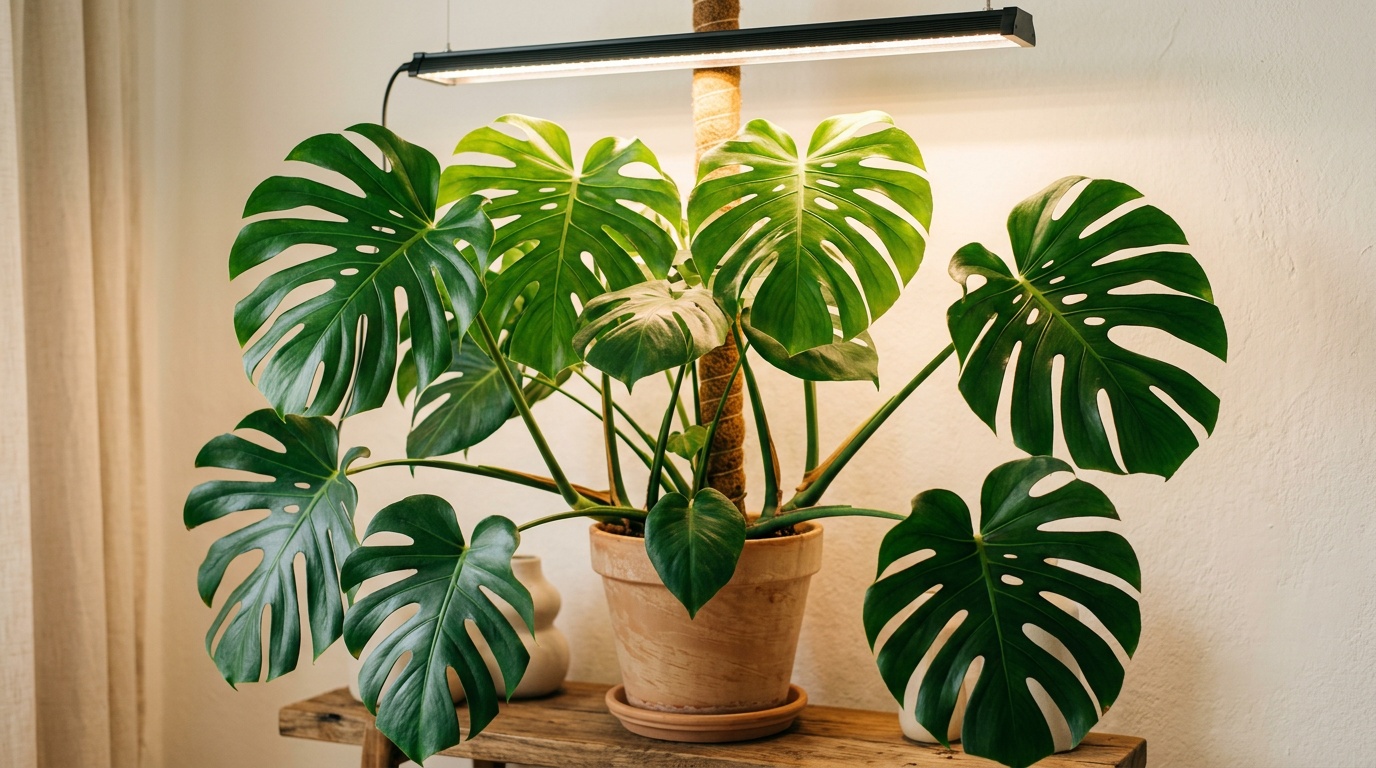
I Added a Grow Light. My Plants Changed in Three Weeks.
Quick answer
Yes, grow lights really do work for houseplants. A full-spectrum LED on a timer — 14 hours on, 10 off, positioned 12–18 inches above the plant — can produce visible changes in growth rate, leaf size, and color within two to three weeks, especially for plants in dim or low-light spots.
There’s a shelf in my living room that gets almost no natural light. It’s one of those spots that looks nice but is basically a slow death sentence for plants. I’d tried a few things there — a pothos that stretched toward nothing, a peace lily that gave up flowering entirely, a little prayer plant that just looked sad. I knew the issue. I kept hoping it wouldn’t matter as much as it did.
Eventually I got a grow light and set it up over that shelf. Three weeks later, the prayer plant had put out two new leaves. The pothos had a new vine going. And the peace lily — it had a bloom spike coming up for the first time in probably eight months.
That’s not an exaggeration, and it’s not because I did anything fancy. Here’s what I actually did and what I’d tell someone who’s thinking about trying one.
Why Your Dim Corner Isn’t Doing Your Plants Any Favors
If you want to understand what your plants are actually getting in a low-light spot, What ‘Low Light’ Really Means — And Why Your Plant Is Probably Starving is worth a read before you go any further. The short version: “low light” indoors is often much darker than we think, and even so-called low-light plants have a floor below which they just stop growing.
That was my shelf. The plants weren’t dying dramatically — they were just existing. No new growth, no energy, leaves staying small. They were surviving on fumes.
A grow light doesn’t replace a sunny window, but it fills in the gap. For a plant sitting in a dark corner, even a modest, affordable light can be the difference between stalling out and actually growing.
Full-Spectrum Is What Matters — Not the Wattage Number
Walk into any hardware store or scroll through Amazon and you’ll see grow lights with all kinds of wattage claims. Some of that is marketing math that doesn’t mean much in practice. What actually matters for houseplants is that the light is full-spectrum — meaning it covers a range of wavelengths that plants can use, similar to natural sunlight.
Plants use blue light wavelengths for leaf and stem growth, and red wavelengths for flowering and fruiting. A full-spectrum LED gives them both, plus everything in between. A plain white bulb or a “daylight” LED from the hardware store might look bright to your eyes but is missing chunks of what the plant actually needs.
The bseah Full Spectrum Grow Light with Timer is the one I ended up with, and it’s been genuinely good. Nothing fancy about the setup — it clipped onto my shelf, the gooseneck let me position it where I needed it, and the built-in timer meant I stopped having to remember to turn it on and off. That last part matters more than I expected.
Set a Timer. Seriously, Just Set a Timer.
Plants need darkness. I know that sounds obvious, but when I first started thinking about grow lights, I wondered if more hours meant more growth. It doesn’t work like that.
Most houseplants do well with 14 hours of light and 10 hours of dark. That dark period is part of how plants regulate their internal cycles — some flowering happens in response to it. Running a light 24/7 isn’t just wasteful, it can actually stress your plants out.
A timer is non-negotiable for me. I set mine to come on at 7am and go off at 9pm, and I don’t think about it again. If your light doesn’t have a built-in timer, grab a basic outlet timer — they’re cheap and it takes two minutes to set up.
Distance Between the Light and Your Plant Actually Changes Everything
This is probably the part most people get wrong, and I get why — there’s no obvious feedback until something goes wrong.
Too close: leaves start to bleach, look washed out, or in worse cases get actual burn spots. Too far: the light spreads out and loses intensity so quickly that by the time it reaches the plant, it’s not doing much.
For most houseplants, 12 to 18 inches between the light and the top of the plant is a good range to work in. I keep mine at about 14 inches above my tallest plant on the shelf. As plants grow, I adjust.
A few things worth knowing:
- Succulents and cacti can often handle being a bit closer, since they’re adapted to intense light
- Ferns and other moisture-loving plants tend to prefer the farther end of that range
- If a plant starts showing bleached patches on the top leaves, move the light up before you assume something else is wrong
If you want to take the guesswork out of light placement across your whole home — not just under a grow light — a light meter is genuinely useful. I mention it in a few places because it changed how I think about placement entirely.
What Actually Changed in Three Weeks (Specifically)
I want to be specific here because vague before-and-afters aren’t that useful.
Prayer plant (Maranta leuconeura): This one showed results the fastest. Within about ten days, I could see a new leaf unfurling. By week three, two full new leaves had opened, and the colors — that deep green with the pink veining — looked more saturated than I’d seen in months. Before the light, the leaves had been a little dull and yellowish-green.
Pothos (golden): Slower to respond, but by week three there was a new vine starting and the newest leaves were noticeably larger than the ones that had grown on the shelf without supplemental light. Leaf size is a pretty reliable indicator — small, stunted leaves often mean the plant is stretching resources thin.
Peace lily (Spathiphyllum): Took the longest to visibly respond, but the bloom spike that appeared around week three hadn’t been there before. Peace lilies will flower without a lot of light, but they won’t flower without enough light, and this one had clearly been below that threshold.
None of these plants were sick. They just needed more light than that corner could provide on its own. That’s it.
Which Plants Respond the Fastest and Most Visibly
Not every plant is going to give you dramatic results in a few weeks, and that’s fine. But if you’re setting up a grow light for the first time and want to see whether it’s working, these are the plants that tend to show visible responses quickly:
| Plant | What Changes First | Timeline |
|---|---|---|
| Prayer plant (Maranta) | Leaf color, new growth | 1–2 weeks |
| Pothos | New vines, leaf size | 2–3 weeks |
| Philodendron | New leaves, stem strength | 2–3 weeks |
| Peace lily | Bloom spike, leaf gloss | 3–4 weeks |
| Ferns | Frond density, color | 3–4 weeks |
| African violet | Blooming | 3–5 weeks |
Slower responders — like snake plants or ZZ plants — will benefit from grow lights too, but they grow slowly regardless, so you might not notice changes for a couple of months. That doesn’t mean the light isn’t helping.
For the Monstera people: yes, grow lights can help, especially if you’re trying to get leaf fenestration (those splits). But honestly, if your Monstera isn’t splitting, light is often only part of the story — Your Monstera Leaves Aren’t Splitting Because of Light, Not Age gets into the rest of it.
Does the Type of Grow Light Matter for Houseplants?
Short answer: full-spectrum LED is what you want for most houseplants, and beyond that, the format is more about your setup than your plants.
- Clip-on or gooseneck lights work well for shelves and single plants. Easy to reposition.
- Hanging grow lights are good if you have a ceiling hook or a plant stand and want to cover a wider area. The Bstrip 25W Hanging Grow Light is a solid option if that setup fits your space.
- Adjustable floor or stand lights let you raise the light as plants grow, which is handy if you’re working with taller plants or a mix of heights.
- LED grow light strips are great for shelving units where you want to tuck light under each shelf — less obtrusive, good coverage across a row of plants.
What I’d skip: anything marketed mainly on wattage without mentioning spectrum. And honestly, you don’t need to spend a lot. The results I saw came from a light that cost under $30.
The Thing Nobody Mentions About Grow Lights
They are a little weird-looking. That pinkish-purple glow is just what full-spectrum grow lights look like in person, and if it’s in a living space you actually use, it might bother you. Some newer lights run with a whiter output that’s less visually jarring — worth checking the product photos before you buy if that matters to you.
Also: grow lights don’t fix everything. If a plant is struggling because the soil is wrong, the pot size is off, or it’s been overwatered, more light won’t solve that. Light is one variable. It’s just that for plants in genuinely dim spots, it’s often the most important one to fix first.
If you’re still figuring out what your plant’s light situation actually is — not just whether it’s “bright” or “low” but what those labels mean in practice — the breakdown of what “bright indirect light” actually means is a good place to start. Once you understand what your plant is actually getting, it’s a lot easier to know whether a grow light is going to help.
FAQ
Do grow lights really work for houseplants? They do, especially for plants sitting in spots that don’t get enough natural light. A full-spectrum LED mimics the range of light from the sun, which gives plants what they need to photosynthesize properly. You’ll usually see results — new growth, deeper color, bigger leaves — within two to four weeks.
How long should a grow light be on each day? For most houseplants, 14 hours on and 10 hours off is a solid starting point. Plants need a dark period too, so leaving the light on all day and night isn’t better — it can actually stress them. A simple outlet timer makes this completely hands-off.
How close should a grow light be to my plants? For most houseplants, 12 to 18 inches between the light and the top of the plant is the sweet spot. Too close and you risk bleaching or burning the leaves. Too far and the light intensity drops off so much that it’s not doing much good.
What is the best grow light for indoor houseplants in 2026? For most people, an affordable full-spectrum LED is all you need — look for one with a built-in timer so you don’t have to think about it. Wattage claims on packaging can be misleading; full-spectrum coverage matters more than a big number on the box.
Frequently asked questions
Do grow lights really work for houseplants?
They do, especially for plants sitting in spots that don't get enough natural light. A full-spectrum LED mimics the range of light from the sun, which gives plants what they need to photosynthesize properly. You'll usually see results — new growth, deeper color, bigger leaves — within two to four weeks.
How long should a grow light be on each day?
For most houseplants, 14 hours on and 10 hours off is a solid starting point. Plants need a dark period too, so leaving the light on all day and night isn't better — it can actually stress them. A simple outlet timer makes this completely hands-off.
How close should a grow light be to my plants?
For most houseplants, 12 to 18 inches between the light and the top of the plant is the sweet spot. Too close and you risk bleaching or burning the leaves. Too far and the light intensity drops off so much that it's not doing much good.
What is the best grow light for indoor houseplants in 2026?
For most people, an affordable full-spectrum LED is all you need — look for one with a built-in timer so you don't have to think about it. Wattage claims on packaging can be misleading; full-spectrum coverage matters more than a big number on the box.