Why Plants Climb (And What They're Actually Doing When They Find a Support)
Quick answer
Climbing plants evolved to reach the forest canopy without building a trunk — they use existing structures instead. Houseplant climbers use one of three strategies: aerial roots, tendrils, or twining stems. Finding a support triggers a biological shift toward larger, more mature leaves — which is why a moss pole genuinely changes how your plant grows.
There’s a reason your pothos looks perfectly happy trailing off a shelf but then puts out noticeably bigger leaves the moment it finds something to grab. That’s not coincidence — it’s the plant doing exactly what it evolved to do. Climbing plants are running a very specific biological program, and understanding what that program actually is makes you a much better caretaker for them. It also explains why some common advice — like just letting a monstera hang — might be quietly working against you.
Climbing Is a Shortcut, Not a Growth Habit
Here’s the core idea: climbing plants evolved to cheat.
In a tropical forest, the canopy is where the good light is. But getting there requires height, and height usually means building a trunk — which takes enormous resources, years of growth, and a lot of structural investment. Trees do it. Shrubs do it to a lesser extent. But somewhere along the evolutionary timeline, certain plants figured out a different path: let something else do the structural work, and just go along for the ride.
That’s what a climbing plant is doing. It’s not building upward — it’s borrowing upward. Instead of investing in thick stems and woody tissue, it invests in the ability to find and attach to an existing structure and use it to reach the light. It’s genuinely clever, and once you see it that way, a lot of their behavior starts to make more sense.
This is also why climbing plants tend to look a little different from true trees or upright shrubs. Their stems are often thinner than you’d expect for their length. Their leaves can vary dramatically depending on whether they’ve found support or not. And they respond to their environment in ways that more self-sufficient plants don’t need to bother with.
Three Ways Houseplants Climb (They’re Not All the Same)
Not all climbing plants use the same strategy, and the differences matter if you’re trying to support them well.
Aerial roots — monsteras, pothos, philodendrons
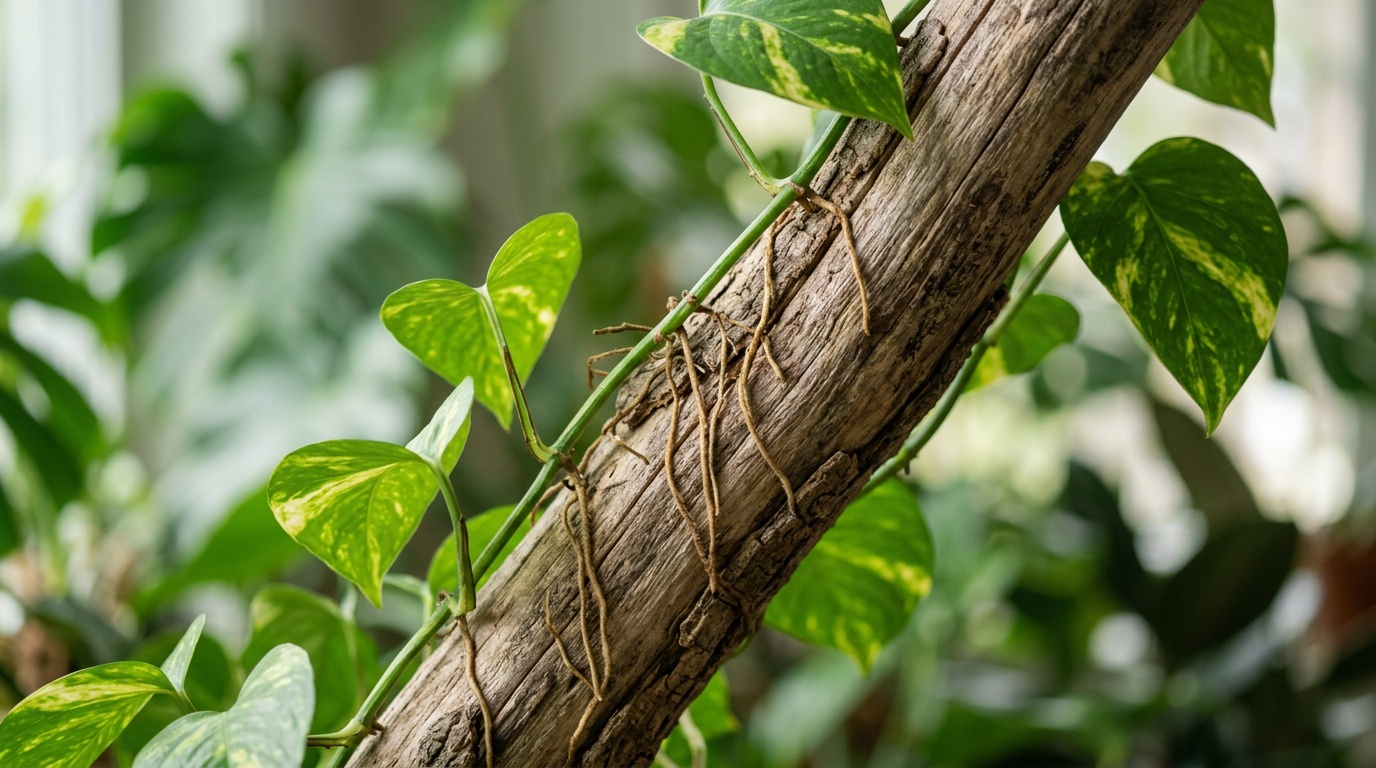
These are the roots you see growing out of the stem above soil level. They’re not a sign something’s wrong. They’re the plant’s primary climbing tool. In the wild, these roots grip the rough bark of a tree and, in many cases, also absorb moisture directly from the surface they’re attached to. That’s a big part of why a moss pole works so well for this group — it gives the aerial roots both something to grip and a source of moisture, which encourages them to attach rather than just hang in the air.
A smooth surface like a plastic stake doesn’t offer the same thing. The roots can’t grip it, so the plant doesn’t really commit to climbing it. You might stake a monstera to a plastic pole and wonder why it keeps flopping sideways — that’s usually why.
Tendrils — passiflora, some hoyas, cissus
Tendrils are modified stems or leaves that are touch-sensitive and coil on contact. They’re thin, curling structures that reach out and wrap around whatever they find — a wire, a trellis bar, another stem. The coiling is a physical response triggered by touch, not something the plant decides to do. It’s mechanical in the most interesting way. These plants do really well on wire or grid trellises where there are plenty of narrow structures to coil around. They don’t attach well to flat surfaces or thick poles.
Twining stems — hoyas (most species), some jasmines, thunbergia
Twiners wrap their actual growing stems around a support as they elongate. The stem itself spirals. These plants are less particular about surface texture than aerial-root climbers, but they do need something with a shape they can wrap around — a thin pole, a wire form, a bamboo stake. Flat surfaces don’t work. And once a twiner has wrapped a few times, it’s genuinely holding on — try to reposition it and you’ll see how committed it is.
| Climbing Type | Examples | Best Support | Key Feature |
|---|---|---|---|
| Aerial roots | Monstera, pothos, philodendron | Moss pole, coco coir pole | Grips and absorbs moisture |
| Tendrils | Passiflora, cissus | Wire trellis, grid | Coils on contact |
| Twining stems | Hoya, jasmine | Thin pole, wire form | Stem spirals around support |
What Actually Happens When a Climbing Plant Finds Support
This is the part I find most interesting, and it’s the reason supporting your climbing plants isn’t just about aesthetics or keeping them tidy.
Climbing plants have two distinct growth modes: juvenile and mature. In juvenile mode, the plant is essentially searching. It produces smaller leaves, grows more horizontally or droopingly, and conserves energy. It’s not fully committing to any direction because it hasn’t found what it’s looking for yet. This is what you’re seeing when a monstera trails off a shelf with leaves that never get very big, or a pothos just keeps producing the same small heart-shaped leaves indefinitely.
When the plant finds a vertical support — especially one its roots or tendrils can actually grip — something shifts. The plant registers that it’s found a structure to climb, and it starts investing in upward growth. The internodes (the spaces between leaves) shorten. The leaves get bigger. And in plants like monsteras, the fenestration — those distinctive splits and holes — starts to develop or become more pronounced.
This is not just about the plant getting older or bigger. It’s a triggered developmental transition. The same plant at the same age will look completely different depending on whether it’s found proper support or not. If you’ve ever wondered why your monstera isn’t splitting even though it seems healthy, this is usually a big part of the answer — I go into the full picture of that over in why your monstera leaves aren’t splitting.
The leaf size side of this is also covered in more depth in why the same plant grows leaves of completely different sizes, because there’s more to the story than just climbing behavior — but the climbing transition is one of the clearest examples of it happening.
Why This Changes How You Should Support Your Plants
Once you understand what’s actually happening, the support you choose stops being a decorative decision and starts being a care decision.
For aerial-root climbers like monsteras, a moss pole isn’t just something to tie the stem to. It’s an invitation for the roots to attach. The LveSunny 49” Bendable Moss Pole works well here because it’s easy to shape as the plant grows and the moss surface gives the roots something real to grip onto. Keeping the moss moist — which you can do with a spray bottle or by just making sure it stays damp when you water — encourages the roots to embed themselves in it, which is when the plant really starts to commit to climbing.
I’d suggest changing the soil around the same time you add support, especially if the plant has been in the same pot for a while. And pot size matters — if the pot is too large, the plant focuses energy on roots rather than upward growth, which can slow the whole transition.
For a deeper look at how the moss pole actually works biologically and why it makes such a difference, why a moss pole actually changes how your monstera grows covers that specifically.
Tendrils climbers like passiflora need a different setup entirely. A moss pole does nothing for them. A grid trellis or wire form gives them lots of narrow attachment points, which is what they need. And twiners like hoyas need a form they can spiral around — which is why hoop trellises are so popular for them. Getting the right support type for your specific plant isn’t fussy, it’s just matching the plant to what it’s actually evolved to use.
The “Vining vs. Climbing” Distinction That Actually Matters
You’ll hear these terms used interchangeably a lot, and honestly, in casual conversation it’s fine. But there is a real difference, and it matters when you’re deciding how to grow something.
A true climber has a physical attachment mechanism — aerial roots, tendrils, or a twining stem. It’s built to find and hold a support. A vining plant just… grows long. It’ll trail or drape, but it doesn’t have any particular drive to attach to anything. Tradescantia is a good example of a viner. Lovely trailing plant, no climbing ambitions.
Some plants can go either way depending on conditions. Pothos is a good example. Left to trail, it’ll trail quite happily and stay in a sort of permanent juvenile state — reasonably sized leaves, decent growth. Give it a vertical moss pole and it switches modes, puts out larger leaves, and starts climbing like it has somewhere to be. It’s the same plant behaving very differently based on what’s available to it.
This is also partly why I have mixed feelings about monsteras as houseplants for everyone. They’re not bad plants — they’re beautiful — but they do get genuinely large, and they grow best when they have room to climb. If you’ve got the space and you give it a proper support, a monstera is remarkable. If you’re trying to keep one in a small apartment without a support, it tends to just sprawl and never really hit its stride. There are other climbing aroids that stay more manageable if space is a concern.
Giving a Climbing Plant What It’s Looking For
Once you see climbing plants as plants with a specific goal — find a structure, go up, get to the light — it’s easier to know what they need. They’re not randomly growing in whatever direction. They’re searching, and when they find what they’re looking for, they shift into a different gear.
Giving your monstera or philodendron a proper moss pole with real sphagnum moss that you keep slightly damp isn’t extra effort — it’s telling the plant it’s found what it needs. The bigger leaves and the fenestration that follow aren’t a reward for good plant parenting. They’re just the plant doing what it was always going to do, once the conditions were right.
Frequently asked questions
How do climbing plants attach to surfaces?
It depends on the plant. Monsteras and pothos use aerial roots that grip rough surfaces and absorb moisture. Passion flowers use tendrils — thin, touch-sensitive stems that coil around anything they contact. Hoyas and other twiners wrap their actual stems around a support as they grow. Each method works differently, which is why some plants do better on a moss pole while others prefer a wire trellis.
Why do some plants grow upward?
Climbing plants evolved in forest environments where light is scarce near the ground. Instead of spending energy building a thick trunk, they essentially hitchhike upward on trees and other structures. Getting higher means more light — so growing upward is a survival strategy, not just a growth habit.
What is the difference between a vining and climbing plant?
Vining plants trail or hang — they'll grow long and draping but don't have a mechanism to actively attach to a surface. Climbing plants have specific adaptations (aerial roots, tendrils, or twining stems) that let them grip and ascend a support. Some plants, like pothos, can do both depending on what's available to them.
Why does my climbing plant have small leaves even though it's growing?
Small leaves on a climbing plant usually mean it's in juvenile mode — growing horizontally or hanging without a vertical support to attach to. When a climber finds something to grab and starts moving upward, it shifts into a more mature growth phase, which produces larger leaves. Giving it a proper support, like a moss pole, is often the thing that triggers that change.