How to Know When to Water Without Any Schedule At All
Quick answer
You don't need a watering schedule — you need to read your plant and soil. Check soil moisture 1–2 inches deep with your finger, lift the pot to feel its weight, or use a soil moisture meter. Each plant has its own dry-down pattern, and that pattern changes with the season.
The idea of watering on a schedule makes sense on the surface — do the thing on the same day every week, keep it simple, don’t forget. But here’s the problem: your plant has no idea what day it is. It dries out based on temperature, light, season, pot size, soil type, and a dozen other things that change constantly. A fixed schedule can’t account for any of that, and that’s exactly why so many plants get overwatered. People aren’t trying to drown their plants — they’re just following a routine that doesn’t match what the plant actually needs.
The good news is that once you shift to reading the plant and the soil instead of the calendar, watering becomes a lot less stressful. And honestly, less mysterious.
Why Watering Schedules Fail (Even for Experienced Plant People)
Think about what actually controls how fast soil dries out. It’s not the calendar — it’s a combination of factors that are always in flux.
Season and light. In summer, longer days and stronger light mean faster evaporation and more active growth. Your plant might need water every five or six days. Come winter, the light drops, growth slows way down, and the soil just… sits there damp for longer. The same plant in the same pot might only need water every twelve to fourteen days. A schedule set in July will absolutely overwater that plant in January.
Pot material. A terracotta pot actively pulls moisture out of the soil through its walls. A plastic pot holds onto that moisture much longer. If you water both on the same schedule, the plastic pot plant is going to stay wet way too long. Clay pots are genuinely great for plants that like to dry out between waterings — that evaporation factor is a feature, not a flaw.
Pot size. A small pot with snug roots dries out faster than a big pot with lots of excess soil. And here’s the tricky part — a pot that’s too large for the plant holds moisture in the bottom where roots can’t reach it, which is a recipe for root rot. Pot size really does matter more than most people think.
Soil mix. Dense, peat-heavy soil holds water much longer than a chunky mix with orchid bark or perlite. The same plant in two different soil types will have totally different watering needs.
Where the plant actually sits. A plant near a heating vent, a drafty window, or a sunny south-facing spot is going to dry out faster than one sitting in a low-light corner. Location affects everything.
All of that variability is why watering schedules tend to fail — they assume conditions stay constant when they really never do.
The Finger Test: Simple, Free, and Actually Works
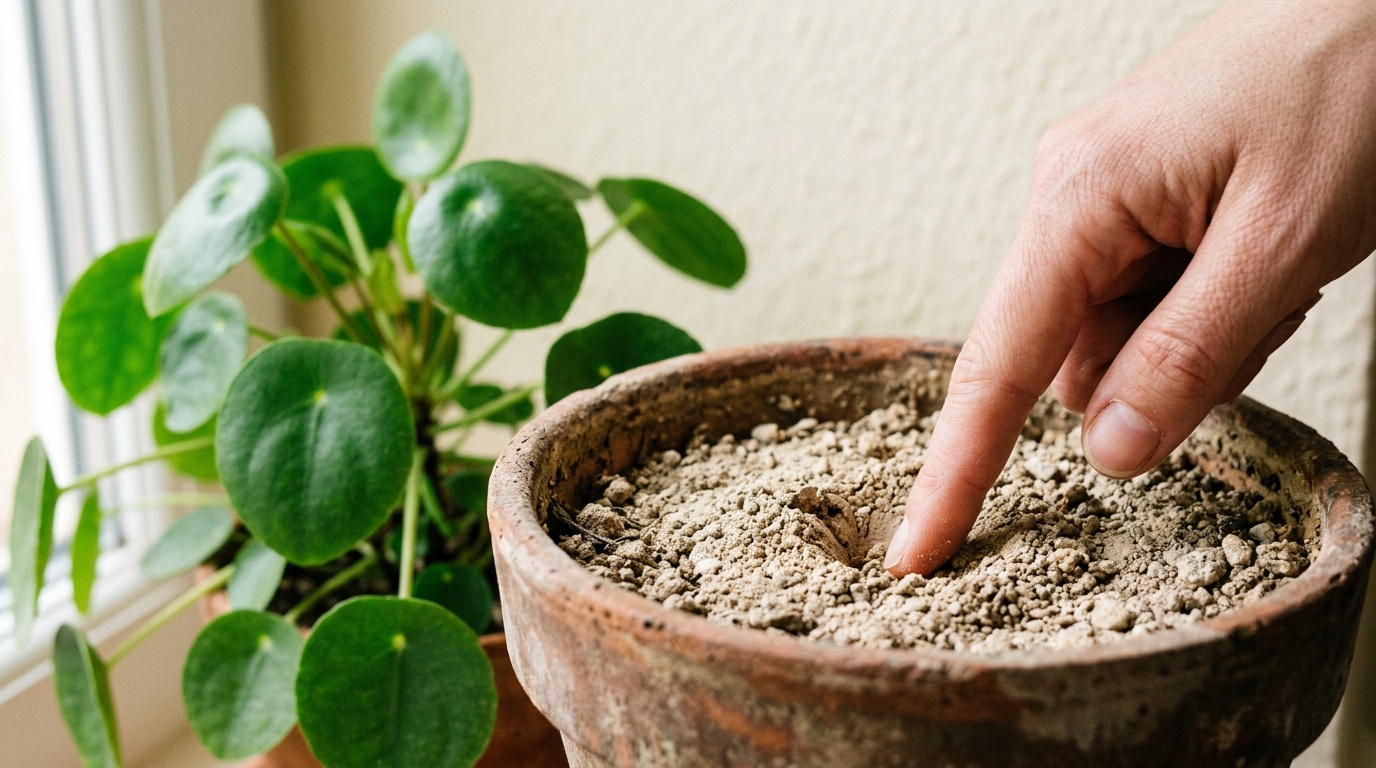
The most reliable thing you can do before watering is just stick your finger into the soil about one to two inches deep. It sounds almost too simple, but it genuinely works.
If the soil at that depth feels dry — like, actually dry, not just the surface — most houseplants are ready for water. If it still feels cool and a little damp, give it another day or two and check again.
A few things worth knowing about the finger test:
- The surface of the soil can look bone dry while the soil two inches down is still pretty moist. This is especially true with dense potting mixes. Don’t water based on the surface alone.
- Different plants have different thresholds. Most tropicals do well when the top inch or two dries out. Succulents and cacti want the soil almost completely dry before watering again. Moisture-lovers like ferns and calathea prefer to stay a bit more consistently damp.
- Your finger is pretty good at this. Cool soil usually means moisture is still there. Room-temperature or slightly warm soil that crumbles away from your finger? Time to water.
The Weight Test: Surprisingly Helpful Once You Get the Feel for It
Pick up your pot right after you water it and notice how heavy it feels. Then pick it up a few days later when the soil is dry. That difference in weight is significant — dry soil is noticeably lighter than wet soil.
Once you’ve done this a few times with the same pot, you start to develop a feel for it. You pick up the pot and just know. It sounds a little abstract, but it becomes second nature pretty quickly. It’s especially handy for plants sitting in spots that are hard to stick a finger into, or for smaller pots where you can easily lift and tip.
Soil Moisture Meters: Worth Having, Especially for Beginners
If you want to take the guesswork completely out of it, a soil moisture meter is genuinely useful. You push the probe down into the soil and it gives you a reading — dry, moist, or wet. No uncertainty, no wondering if your finger is giving you accurate information.
I’ve found the Fpxnb Soil Moisture Meter works really well for this. It’s straightforward to use and saves a lot of second-guessing, especially when you’re still learning a new plant’s patterns. If you’re curious whether these meters are actually accurate or whether the cheaper ones hold up, I dug into that more in this post about whether soil moisture meters actually work — worth a read before you buy.
One thing to know: moisture meters tell you about the soil at the depth you push the probe. If your pot is deep, check in a couple of spots. And rinse the probe off after each use — soil buildup affects the readings over time.
Different Plants Dry Down Differently — Know Your Plant Type
This is probably the biggest shift in thinking: stop organizing watering by day of the week and start organizing it by plant type and its natural dry-down pattern.
Here’s a rough breakdown:
| Plant Type | Examples | When to Water |
|---|---|---|
| Succulents & cacti | Echeveria, haworthia, aloe | Soil almost completely dry |
| Most tropicals | Pothos, philodendron, monstera | Top 1–2 inches dry |
| Moisture lovers | Ferns, calathea, peace lily | Soil barely starting to dry |
| Orchids | Phalaenopsis, dendrobium | Roots silvery-grey, medium dry |
A succulent sitting in the same window as a pothos is going to need water far less often. Watering them on the same schedule will either leave the succulent waterlogged or keep the pothos constantly thirsty. They just have different needs, and that’s okay — you just have to know which category your plant falls into.
If you’ve got a plant that’s wilting and you’re not sure whether it’s too dry or actually overwatered, that’s a different situation with different signals. The post on telling the difference between an overwatered and underwatered plant walks through exactly how to figure that out — because the fix for each one is completely opposite.
Learning Your Plant’s “Dry-Down Pattern”
Here’s the framework that actually makes all of this click into place.
Every plant in every specific spot in your home has its own dry-down pattern — the amount of time it takes to go from fully watered to ready-to-water-again. That pattern is shaped by everything we already talked about: light, pot, soil, season, location. And it shifts over time.
The goal is to learn that pattern for each of your plants, in their specific spots. Here’s how to do it:
- Water thoroughly — enough that water comes out the drainage hole. (Good drainage is non-negotiable. Most plants really do need a pot that drains well.)
- Start checking the soil after a few days using the finger test or a moisture meter.
- Note when the soil reaches your plant’s threshold — whether that’s the top inch dry, or almost fully dry, depending on the plant.
- Water at that point, then start the cycle again.
After a few rounds of this, you’ll notice a pattern emerging. “Oh, this pothos in the north window takes about ten days in spring.” “This succulent on the sunny ledge dries out in about eight days in summer.” That becomes your signal — not a day on the calendar, but a felt sense of your plant’s actual rhythm.
In winter, expect that pattern to stretch out significantly. Less light, less evaporation, slower growth. A plant you were watering every eight days in August might go fifteen days or more between waterings in January. That’s completely normal. Just keep checking the soil and let it tell you.
A Few Other Things Worth Knowing
Bottom watering is great for a lot of plants. Setting the pot in a tray of water and letting the soil absorb from the bottom encourages roots to grow downward and makes sure the whole root zone gets moisture — not just the top. It works especially well for plants in dense soil mixes or anything that tends to get dry patches.
Self-watering pots are a different conversation. They keep the soil consistently moist, which works fine for some plants but is too wet for others — especially anything that needs to dry out between waterings. If you tend to forget to water, they can be genuinely helpful. Just know that not every plant will be happy in one.
Don’t overthink it. The goal here isn’t perfection — it’s paying attention. If a plant isn’t looking great and you suspect it might be a watering issue, check the soil, move it if the location might be part of the problem, and adjust from there. Plants are pretty good at giving you feedback if you’re watching.
The calendar is a terrible watering guide. The soil is a great one. Once you start checking the soil instead of checking the date, you’ll probably find that watering gets easier — and that your plants start doing noticeably better.
Frequently asked questions
How often should I water my houseplants?
There's no single answer — it depends on the plant, the pot, the soil, the season, and where the plant sits in your home. A tropical in a south-facing window in July might need water every 5 days. The same plant in winter might go 14 days or more. Check the soil, not the calendar.
Is it better to water plants on a schedule?
Not really. A fixed schedule ignores all the variables that affect how fast soil dries out — season, light, pot material, soil type, and plant size. Checking the soil before you water will serve your plants much better than watering every Tuesday.
How do I know my plant needs water?
Stick your finger 1–2 inches into the soil. If it feels dry, most plants are ready to water. If it still feels cool or damp, wait. You can also lift the pot — dry soil is noticeably lighter. A soil moisture meter takes the guesswork out entirely.
When should I water indoor plants in winter?
Less often than you think. Most houseplants slow down in winter, and lower light means slower evaporation. A plant that needed water every week in summer might only need it every two weeks or more in winter. Always check the soil before watering, especially in the colder months.