Your Plant Is Telling You When It Needs Repotting. Here's How to Hear It
Quick answer
A plant needs repotting when you see roots escaping drainage holes, water running straight through the pot, stunted growth despite good care, or a pot that keeps tipping over. Some plants — like hoyas and peace lilies — actually bloom better when root-bound and shouldn't be repotted on a rigid schedule.
Your plant does not know what month it is. It doesn’t know that spring is supposed to be repotting season. What it does know is whether its roots have room to grow, whether water is moving through the soil correctly, and whether it has what it needs to keep doing its thing. Those are the signals worth paying attention to — and they can show up in January just as easily as April.
The “repot every spring” advice is one of those rules that kind of makes sense in theory but falls apart pretty fast in practice. Some plants need repotting more often than that. Some need it less. And a handful of plants genuinely do better when you leave them alone in the same pot for years. Knowing the difference saves you a lot of unnecessary stress — yours and the plant’s.
Five Signs Your Plant Is Actually Ready for a New Pot
These aren’t subtle. Once you know what to look for, plants are pretty straightforward about asking for more space.
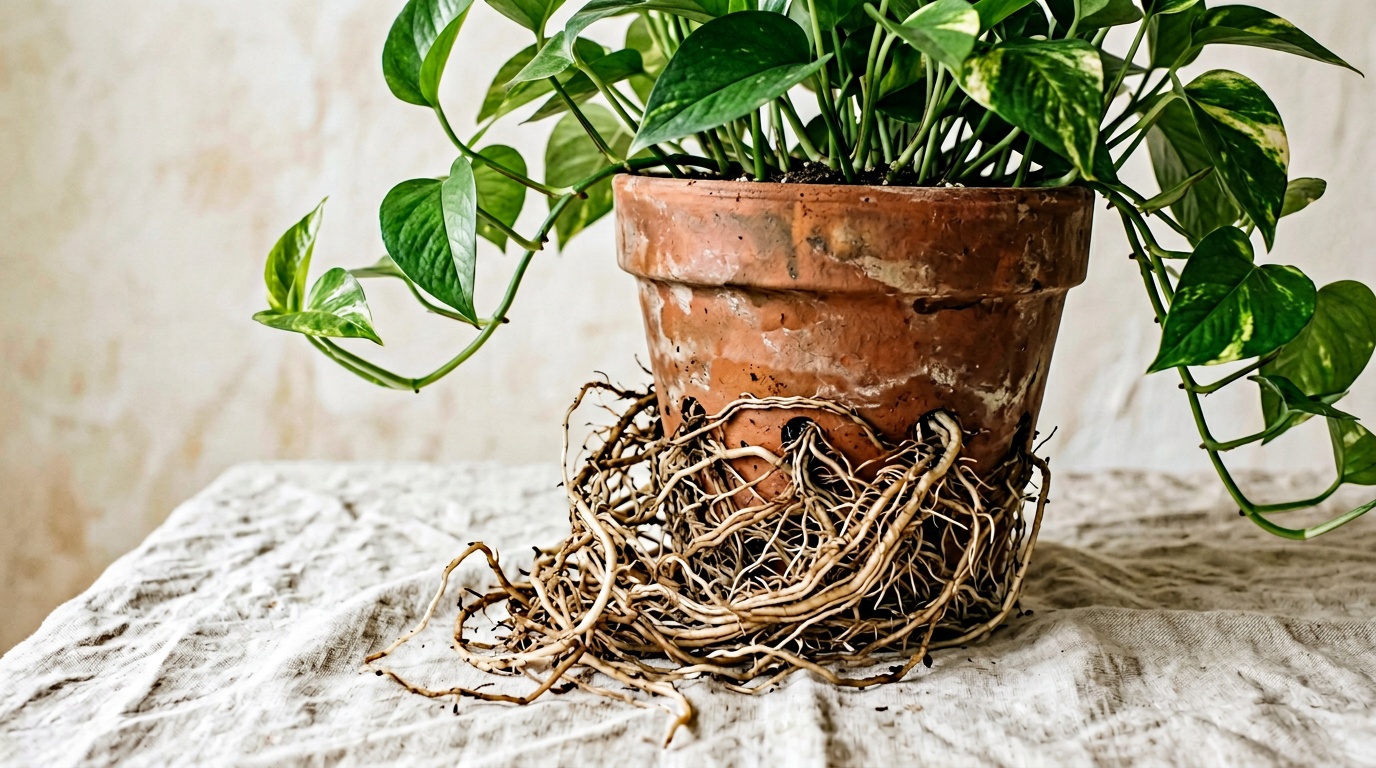
Roots growing out of the drainage holes. This is the most obvious one. If you flip your pot over and see roots poking out, or wrapped around the bottom, the plant has run out of room. It’s not automatically an emergency, but it’s a clear message.
Roots circling the surface of the soil. Pull the plant gently out of its pot (or just look at the top of the soil) and check whether roots are visibly spiraling around the edges or pushing up above the soil line. That’s a root-bound plant looking for somewhere to go.
Water runs straight through without absorbing. You water, and it goes right out the bottom almost immediately — not slowly draining, but rushing through like there’s almost nothing stopping it. That usually means the roots have taken up so much space that there’s barely any soil left to hold moisture. The water has nowhere to go but down and out.
If you’re dealing with this and you’re not sure whether it’s a root issue or a soil issue, it might be worth reading about what perlite actually does and why it matters for drainage — sometimes what looks like a root problem is partly a soil structure problem too.
Growth has stalled and you can’t figure out why. If you’ve checked your light, you’ve been watering consistently, and your plant just… isn’t growing — it hasn’t pushed out a new leaf in months, or new leaves are coming in noticeably smaller than older ones — being root-bound is worth considering. The roots have nowhere to expand, so the plant slows down.
The pot is becoming unstable. If your plant keeps tipping over even though you haven’t changed anything, it’s probably gotten top-heavy. The plant has outgrown its base. This is especially common with things like fiddle-leaf figs, snake plants, and monsteras once they really get going.
The Counter-Argument: Some Plants Bloom Better When They’re Root-Bound
Here’s the thing people don’t talk about enough — not every crowded root system is a problem. Some plants actually respond to being root-bound by blooming more.
Hoyas are a good example. They tend to flower more reliably when their roots are cozy and a little cramped. Same goes for spider plants, peace lilies, and African violets. If you’ve got a hoya that hasn’t bloomed and you’ve been repotting it on schedule trying to help it along, you might actually be working against yourself.
So before you repot something out of habit or a vague feeling that it’s “been a while,” check whether it’s showing any of the actual signals above. A plant that’s sitting comfortably in its pot, growing at its own pace, not showing root-bound symptoms — that plant probably doesn’t need anything from you right now except your regular care.
Does It Matter When You Repot? Spring vs. Summer vs. Anytime
Spring gets recommended so often because plants are typically coming out of a slower winter period and heading into active growth — so they have the energy to recover from the disruption and push new roots into fresh soil quickly. That logic is real.
But it’s not a hard rule. If your plant is showing clear signs of being root-bound in August, waiting until March isn’t doing it any favors. Repot when the plant needs it. If you’re in the middle of summer and your plant is actively growing, it’ll handle repotting fine as long as you give it a little extra attention afterward — shade it from harsh direct sun for a few days, don’t fertilize right away, and keep the soil consistently moist (not soggy) while it settles.
The one time I’d genuinely try to wait is dead winter, if your plant has gone very dormant and slow. Not because repotting in winter will automatically cause problems, but because a dormant plant in cold, low-light conditions doesn’t have a lot of energy to push new roots, and that’s what it needs to do to recover well.
How to Pick the Right Pot Size (This Is Where a Lot of People Go Wrong)
One size up. That’s the general idea, and it’s more specific than it sounds.
If your plant is currently in a 4-inch pot, go to a 6-inch pot. In a 6-inch pot, go to an 8-inch. You’re looking for roughly 1 to 2 inches more diameter, not a dramatic upgrade.
The reason this matters: a pot that’s too large holds a lot more soil than the roots can reach. All that extra soil stays wet for a long time, and wet soil with no roots drinking from it is how root rot starts. I’ve written more about catching and dealing with root rot over in Root Rot Isn’t Always a Death Sentence — Here’s How to Save the Plant, but the honest best move is to just not create the conditions for it in the first place.
Pot material is worth thinking about too. Plastic pots hold moisture longer, which is fine for plants that like consistently moist soil — but for plants that want to dry out between waterings, a clay or terracotta pot is genuinely better because it lets water evaporate through the walls. It’s not just aesthetics, it actually changes how often you need to water.
One small thing that makes repotting cleaner: covering your drainage holes with a mesh pad before you add soil. It keeps the soil in without blocking drainage, which is the whole point of having holes in the first place.
What to Do Right After Repotting (And What to Skip)
Water it in gently. Not a huge drench, just enough to help the soil settle around the roots and make contact. If the soil is pulling away from the edges of the pot, that’s a sign it needs a little more water to settle properly.
Give it some lower light for a few days. Repotting is stressful even when you do everything right. The plant is dealing with disturbed roots and new surroundings. Bright direct light on top of that is a lot. Move it somewhere slightly shadier for about a week, then gradually bring it back to its normal spot.
Don’t fertilize for 4 to 6 weeks. Fresh potting soil has nutrients in it, and a plant that just had its roots disturbed isn’t in a great position to process a fertilizer hit on top of everything else. Hold off. Once you start seeing new growth, that’s usually a good signal that the plant has settled in and you can get back to your regular routine.
Don’t immediately panic if it droops. Some plants look rough for a week or two after repotting. That’s pretty normal. As long as you’re not seeing yellowing leaves, mushy stems, or signs of root rot, give it time.
What About the Soil You’re Repotting Into?
That’s its own conversation, and I’ve gone into it in detail over at Why Store-Bought Potting Mix Is Slowly Killing Your Tropicals. The short version: the bag of generic potting mix from the hardware store is convenient, but it’s not ideal for most tropicals. Over time it compacts, stops draining well, and can hold too much moisture.
The mix I use for most of my plants is built around coco husk fiber, sphagnum moss, orchid bark, worm castings, and a little charcoal. It stays loose and airy, drains well, and doesn’t compact the way a lot of store-bought soil does. The roots seem to spread into it really easily, which means the plant establishes in its new pot faster.
A Quick Reference: Root-Bound Signals vs. Leave-It-Alone Signals
| Repot Soon | Probably Fine to Wait |
|---|---|
| Roots out of drainage holes | No roots visible at the surface |
| Water runs straight through | Water absorbs normally |
| Roots visibly circling at top | Steady, healthy growth |
| Growth stalled despite good care | Plant is flowering well |
| Pot tipping over from top-heaviness | Pot is stable |
| Soil breaking down, pulling away from edges | Soil still looks and drains well |
The Main Thing
Paying attention to your individual plant beats following a calendar every time. Most plants will tell you pretty clearly when they’ve outgrown their pot — you just have to know what to look for. And if a plant is sitting there happily blooming, growing at its own pace, showing no signs of stress? Leave it alone. It’s doing fine.
Frequently asked questions
How do I know if my plant needs repotting?
Look for roots growing out of the drainage holes, roots circling the top of the soil, water that runs straight through the pot without absorbing, growth that has stalled despite good light and regular watering, or a pot that keeps tipping over because the plant has gotten top-heavy. Any one of these is a good reason to take a closer look.
Should I repot my plant every year?
Not necessarily. Repotting every year works for some fast-growing plants, but plenty of houseplants are perfectly happy staying in the same pot for two, three, or even more years. Some plants — like hoyas, spider plants, and peace lilies — actually bloom better when they're a little root-bound. Let the plant tell you when it's ready rather than going by the calendar.
What happens if you don't repot a plant when it needs it?
If a plant is genuinely root-bound and needs more space, leaving it too long can slow growth, cause the soil to break down faster, and make it harder for water to absorb properly. In some cases the roots can crack or deform a plastic pot. That said, not every plant that hasn't been repotted in a while is suffering — check for the actual signs before you assume it needs a new home.
What size pot should I use when repotting?
Go up one size — usually about 1 to 2 inches larger in diameter than the current pot. A pot that's too big holds more soil, which holds more moisture, which can lead to root rot before the roots have a chance to grow into it. Bigger isn't better here.