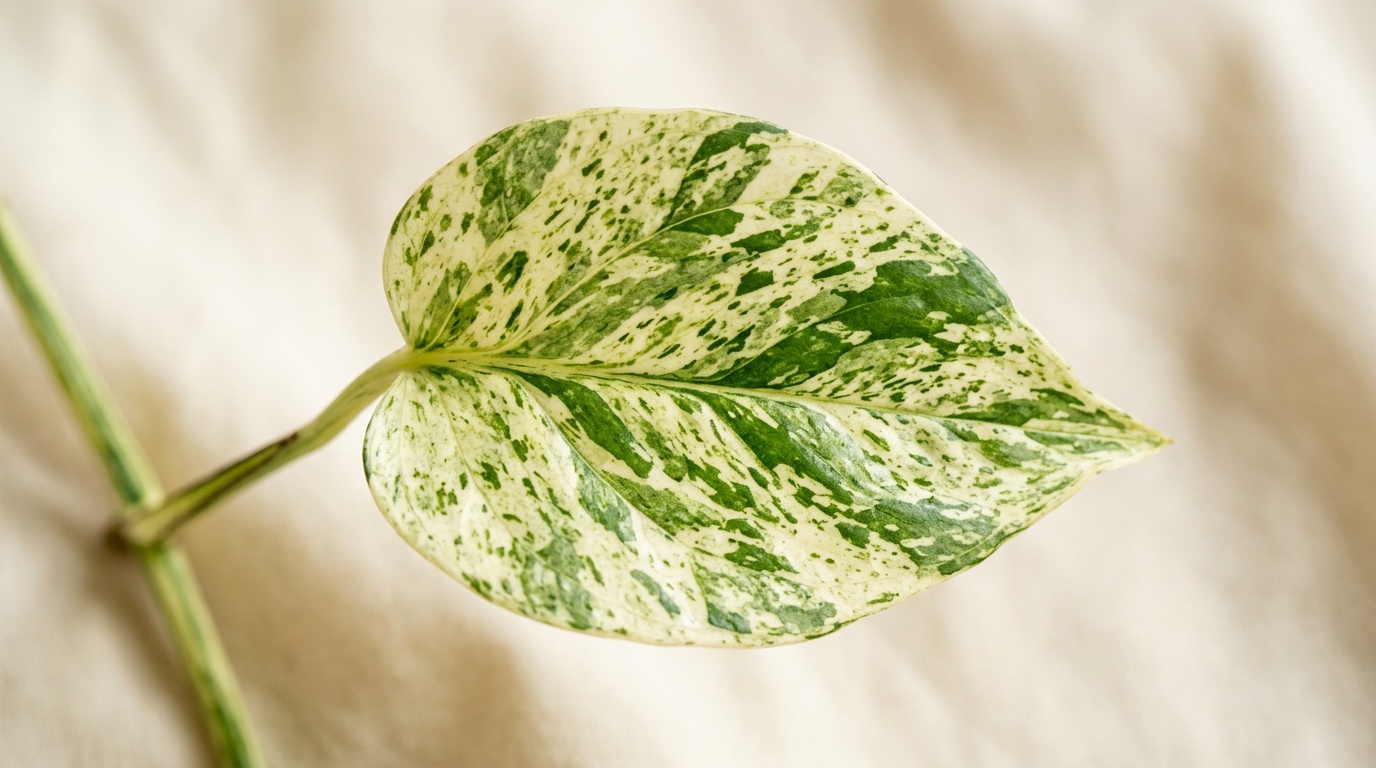
Why Variegated Plants Are So Expensive (And Why the Pattern Can Disappear)
Quick answer
Variegated plants are expensive because they grow slowly, can only be propagated by cuttings, and demand far exceeds supply. The white or pale patterning is caused by reduced chlorophyll — a mutation, not a decorative trait — which also makes some varieties unstable and prone to reverting to solid green.
The pattern is pretty — but it’s actually a flaw the plant is working around
When you see those creamy white splashes across a monstera leaf, it’s easy to think the plant was designed that way. It wasn’t. The white, yellow, or pale green sections exist because those cells aren’t producing chlorophyll the way they’re supposed to. The plant isn’t decorated — it’s dealing with a mutation, a genetic quirk, or in some cases an actual virus. And that distinction matters a lot when you’re thinking about why these plants are priced the way they are, and why they sometimes just… stop looking the way you paid for.
Variegation is genuinely fascinating once you understand what’s causing it. There are a few different mechanisms, and they behave very differently from each other. Some are stable for the life of the plant. Some can reverse course on you. And one type is contagious.
There’s more than one kind of variegation — and they’re not all equal
This is the part most people don’t know, and it changes everything about how you care for these plants and what you’re actually buying.
Chimeral variegation — the unstable kind
This is what you’re dealing with in the two most famous (and most expensive) variegated monsteras: the Monstera deliciosa ‘Albo Variegata’ (Albo Monstera) and the Thai Constellation.
Chimeral variegation happens when a plant has two genetically different populations of cells growing alongside each other. Some cells produce chlorophyll normally. Others — the ones responsible for the white or pale yellow coloring — have a mutation that stops them from doing that. The word “chimera” comes from Greek mythology, a creature made of parts from different animals. That’s basically what’s happening in the plant tissue.
The Thai Constellation is a lab-produced chimera that originated from tissue culture, and it tends to be a bit more consistent in its patterning — the cream-colored speckles are fairly reliable from leaf to leaf. The Albo is less predictable. You might get a leaf that’s half white, then a fully green leaf, then a beautiful marbled one. That randomness is part of its appeal for some people, and part of the frustration for others.
The important thing to know about chimeral variegation: it can shift. The ratio of mutated cells to normal cells isn’t fixed. Given the right conditions — or sometimes for no obvious reason — the plant can produce growth that’s mostly or entirely green.
Stable pigment-based variegation — the reliable kind
Some plants are variegated because of actual pigments, not missing chlorophyll. Certain Calathea, Aglaonema, and Tradescantia varieties fall into this category. The pattern is written into their genetics in a stable way — it doesn’t revert, it doesn’t shift, and it breeds true from seed in many cases.
If you have a Tradescantia zebrina with those silvery stripes, you’re not going to wake up one day to find it’s gone all green on you. That variegation is just how that plant works. No drama.
Viral variegation — the one that surprises people
Yes, some variegation is caused by a plant virus. The most well-known example is certain Hosta varieties and historically some tulips — the famous “broken tulips” that caused Tulip Mania in 17th century Holland were actually infected with mosaic virus.
Viral variegation can create really striking patterns, but it’s worth knowing that a virus is involved because it can spread to other plants through shared tools, pests, or contact. If you’re propagating or pruning plants and you suspect viral variegation, cleaning your tools between cuts is worth doing anyway as a general habit.
Why variegated plants are so expensive
People ask this a lot, especially about variegated monsteras. A few years ago, Albo Monstera cuttings were selling for hundreds of dollars. Prices have come down somewhat as more plants entered the market, but they’re still significantly more expensive than the regular green version. Here’s why:
They grow slowly. A variegated plant has less chlorophyll than its all-green counterpart. Chlorophyll is how plants capture light and produce energy. Less chlorophyll means less energy means slower growth. A regular Monstera deliciosa can put out new leaves fairly quickly under good conditions. An Albo takes its time. That slow growth pace limits how fast anyone can produce stock to sell.
They can only be propagated by cuttings. You can’t grow a chimeral variegated plant from seed and expect the offspring to be variegated in the same way. The mutation doesn’t pass down reliably through seeds. The only way to get more of them is to take stem cuttings from an existing variegated plant — one node at a time. That’s a slow, hands-on process.
Demand has been high. Social media drove a massive wave of interest in variegated plants, and the supply side simply couldn’t keep up with how fast the demand grew. Basic economics did the rest.
The Thai Constellation is a partial exception — because it was developed in tissue culture (a lab process where tiny plant fragments are multiplied in controlled conditions), it became more available than the Albo over time, which is part of why it’s generally a bit less expensive now.
If you’re caring for a variegated monstera and want to give it a fertilizer designed for the plant, HiThrive Monstera Plant Food (16oz) is worth looking at — a mild, regular feeding works well for slow-growing variegated varieties without pushing too much green growth.
The reversion problem — and what to do about it
This is the part that makes people nervous, and for good reason. If you have a chimeral variegated plant, reversion is a real risk.
When a variegated plant puts out a stem or leaf that’s fully green with no variegation at all, that section has a big advantage over the rest of the plant: it can photosynthesize more efficiently. It grows faster. And if you leave it alone, it will eventually outcompete the slower-growing variegated portions. Over time, you can end up with a plant that barely shows any variegation at all — or none.
The fix is pretty straightforward, but you have to actually do it: prune the green growth back to the last node that showed variegation. Don’t wait. Don’t hope the next leaf will be more interesting. Cut it.
This feels a little aggressive at first, especially if the green growth looks healthy and lush. But leaving it is how you lose the variegation you paid for.
A few other things that seem to help:
- Keep light levels high. Low light pushes plants toward producing more chlorophyll — which makes sense, they’re trying to survive. A well-lit spot gives the variegated sections a better chance of holding on. If your space is dim, a bseah Full Spectrum Grow Light with Timer can make a real difference for keeping variegated plants happy indoors.
- Don’t stress the plant. Dramatic environmental changes, severe underwatering, repotting shock — these can all push unstable plants toward producing more green growth. Consistency helps.
- Watch the new growth. Get in the habit of checking each new leaf as it unfurls. If you notice a trend toward less variegation, that’s your cue to look at what’s changed in the plant’s environment.
Caring for white-heavy leaves (the ones that are almost all pale)
Leaves that are mostly or entirely white are genuinely beautiful — and genuinely fragile. Because those sections have almost no chlorophyll, they can’t protect themselves from light stress the way normal leaves can. They sunburn more easily, and they don’t contribute much to the plant’s energy production.
A plant with a lot of heavily white leaves is essentially being supported by whatever green tissue it has left. It needs bright, indirect light — not harsh direct sun. It’ll grow even more slowly than a plant with more balanced variegation. And it may be more prone to leaf damage overall.
This is also worth keeping in mind when people chase the “most white” specimens. A plant that’s 80% white is stunning, but it’s working harder just to stay alive. Some people find that really appealing; others find the maintenance stressful. Either way, going in with realistic expectations helps.
If your variegated monstera is climbing — and eventually it will want to — giving it something to grow up makes a real difference in leaf size and overall plant health. You can read more about why that is in Why Plants Climb (And What They’re Actually Doing When They Find a Support). A LveSunny 49” Bendable Moss Pole works well for monsteras because you can shape it as the plant grows.
A quick comparison of the three variegation types
| Type | Examples | Can it revert? | Propagation | Notes |
|---|---|---|---|---|
| Chimeral | Albo Monstera, Thai Constellation | Yes | Cuttings only | Unstable; prune green growth promptly |
| Pigment-based | Tradescantia, many Calathea | No | Cuttings or seed | Stable and reliable |
| Viral | Some Hosta, historic tulips | Depends on virus | Cuttings (carefully) | Can spread to other plants |
One more thing worth knowing
Variegation interacts with leaf size in interesting ways — plants with less chlorophyll sometimes compensate by growing larger leaves to capture more light. If you’ve noticed that your monstera’s leaves seem to vary a lot in size depending on conditions, that behavior is worth understanding on its own. Why the Same Plant Grows Leaves of Completely Different Sizes gets into that if you’re curious.
Variegated plants aren’t harder to keep alive than regular ones, exactly — but they do ask you to pay a little more attention. The pruning matters. The light matters. And knowing which kind of variegation you’re actually dealing with tells you a lot about what to expect. An Albo and a Tradescantia are both “variegated plants,” but they’re working on completely different systems, and treating them the same way would miss the point entirely.
Frequently asked questions
Why do variegated plants cost so much?
Variegated plants grow significantly slower than their all-green counterparts because they produce less chlorophyll. They can't be grown from seed reliably — they have to be propagated by cuttings — which limits supply. When demand is high and supply is slow to grow, prices go up. That's really the whole story.
Can a variegated plant revert to green?
Yes, some can. Plants with chimeral variegation — like Albo Monstera — can absolutely push out solid green growth. If you don't prune that green growth back, it will eventually take over the plant because it grows faster. Not all variegated plants have this risk though. Stable, pigment-based variegation doesn't revert.
How do I keep my variegated plant from reverting?
Prune any fully green stems or leaves back to the last node that showed variegation. Don't let solid green growth stay on the plant — it grows faster than the variegated sections and will crowd them out over time. Keep light levels high, since low light can push the plant toward producing more chlorophyll.
What is chimeral variegation?
Chimeral variegation happens when a plant has two genetically distinct types of cells growing side by side — some that produce chlorophyll normally, and some that don't. It's essentially a genetic mutation. Because the two cell types can shift in proportion as the plant grows, this kind of variegation is unstable and can change or disappear.