The Only Plant Tools I've Used Consistently for Three Years
Quick answer
The most useful houseplant tools for beginners are a soil moisture meter, a long-spout watering can, sharp pruning snips, a small spray bottle, and a free light meter app. These five things solve the most common problems — overwatering, messy watering, bad cuts, dry propagations, and guessing at light levels.
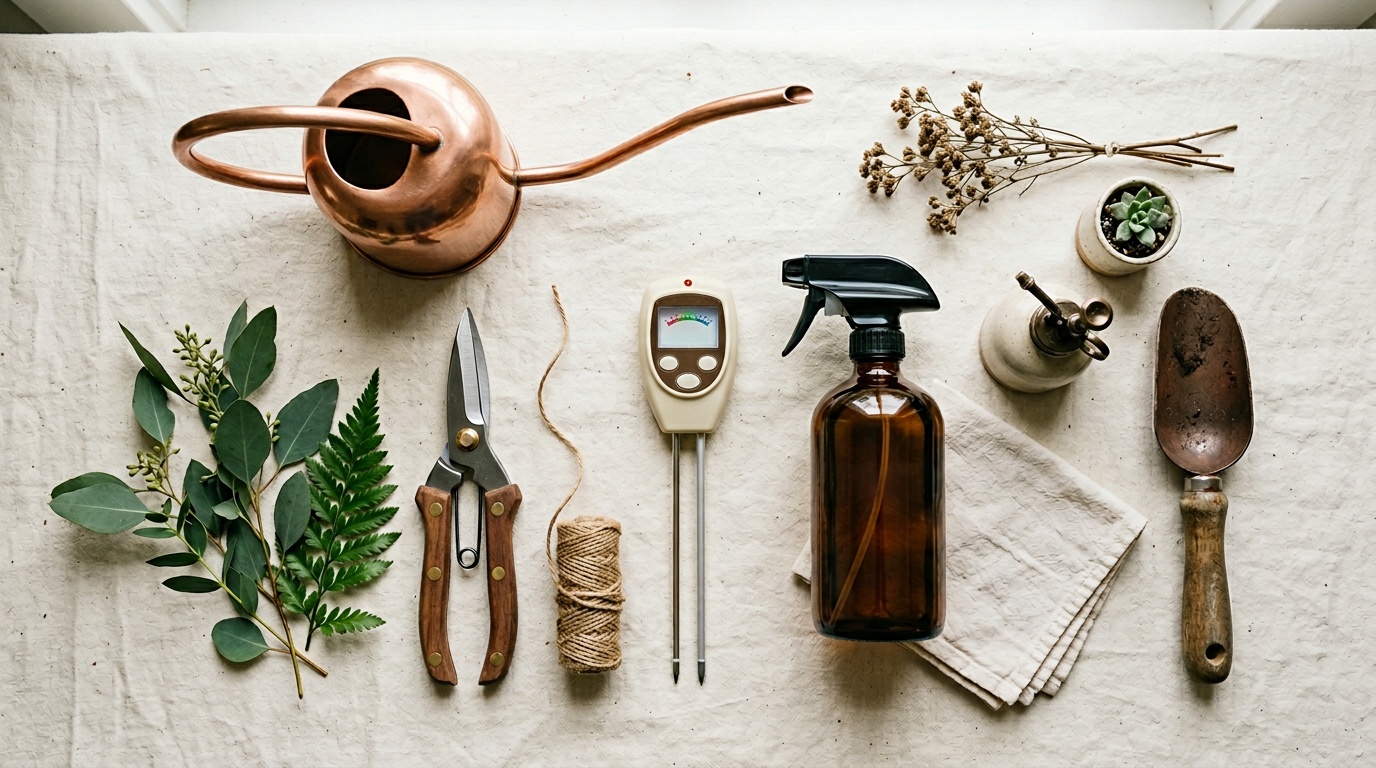
I have a small basket on my plant shelf that holds the things I actually use. Not a collection, not a kit — just the stuff that kept solving problems until it became habit. People at work ask me about plant care pretty regularly, and when they do, I don’t walk them through a shopping list. I just tell them what’s in the basket.
After about three years of keeping that basket more or less the same, I figured it was worth writing down. My test was simple: have I used this more than ten times in the last year? If it didn’t clear that bar, it didn’t make the cut.
A Soil Moisture Meter Stopped Me from Guessing
This is the one I recommend first, every time. The most common reason beginners lose plants isn’t neglect — it’s overwatering. People water on a schedule, or they water because the soil looks dry on top, or they water because they think plants need a lot of water to grow. And then the roots sit in wet soil and start to rot.
Each plant has its own timeline. Some want to dry out almost completely between waterings. Others like to stay a little moist. You can learn to tell the difference by feel once you’ve been doing this a while, but when you’re starting out, a soil moisture meter just tells you. You push the probe into the soil, check the reading, and know whether to water or come back in a few days.
I’ve used mine so many times I stopped counting. The probe goes into the pot, and if it reads dry, I water. If it reads moist, I walk away. That’s it. No more second-guessing, no more lifting the pot to feel the weight, no more pulling out soil with my finger and still not being sure.
If you’re wondering whether a cheaper meter is worth buying or whether you need to spend more — I actually wrote a whole separate piece on that: Soil Moisture Meters: Do the Cheap Ones Actually Work?. Short version: for most home plant care, a basic one does the job.
A Long-Spout Watering Can Is About Precision, Not Looks
You’ve probably seen these — the tall, narrow-spouted cans that look nice in plant photos. I’ll be honest, I bought mine partly because it looked good. But I kept using it because it actually works better.
The problem with a wide-mouthed can or a pitcher is that water goes everywhere. You splash the leaves, you drench the surface unevenly, and if your plants are grouped together on a shelf, you end up watering whatever’s nearby whether it needs it or not. With a long spout, you can guide the water right to the base of the plant, right to the soil, without disturbing anything around it.
It also makes bottom watering easier to manage. I set pots in a tray and use the long spout to fill the tray slowly without overflowing. Bottom watering is genuinely great for a lot of plants — it lets the roots pull up water from below and encourages deeper root growth — and a good spout makes the whole process less messy.
The spout is really the whole thing with a watering can. Length, the angle, how the water flows. I’m planning to write more about what to actually look for, but the short version is: don’t buy a can based on how it looks. Pick it up, feel the balance when it’s full, and check whether the spout gives you control.
Sharp Pruning Snips Are Worth It for One Simple Reason
I used regular scissors on my plants for an embarrassingly long time. Then I switched to a dedicated pair of pruning snips, and the difference was immediately obvious.
Sharp, clean cuts heal faster and cleaner than torn or crushed stems. When you use dull scissors, you’re not really cutting — you’re compressing the stem until it finally gives. That kind of damage is a stress point for the plant, and it can invite disease in. A good pair of snips cuts through in one motion and leaves a smooth edge.
I use mine for trimming dead leaves, cutting back leggy growth, taking cuttings for propagation, and occasionally snipping off a stem that’s just going in the wrong direction. Probably a few times a week across all my plants.
You don’t need to spend a lot. You do need something that’s actually sharp and stays sharp. I’d rather have one good pair than three mediocre ones. The Mini Garden Tool Set (5-Piece) is a decent option if you want a starting kit that includes snips along with a few other small tools — it’s what I’d suggest if someone asked me what to buy first.
Clean your snips between plants if you’re dealing with anything that looks sick. A quick wipe with rubbing alcohol is enough. It’s a simple habit that keeps you from spreading problems from one plant to another.
A Spray Bottle Has One Job in My Setup
I want to be specific here, because “misting your plants” is advice that gets thrown around a lot and it isn’t really useful as a general practice. Misting the leaves of most houseplants doesn’t meaningfully raise humidity, and if you do it too much or at the wrong time of day, you can actually encourage fungal problems.
But a spray bottle does have a job I use it for all the time: propagations.
When I’m rooting cuttings — whether they’re sitting in water, in moss, or in a small pot of soil — I want to keep things consistently moist without waterlogging anything. A spray bottle lets me do that. A few spritzes every day or two, right where the cutting meets the medium, keeps moisture where it needs to be.
I also use it for cuttings that are just starting to establish roots and aren’t ready for a full watering yet. It gives me a lot more control than trying to add a small amount of water from a can.
That’s basically it. It’s not a tool I’d say everyone needs right away, but if you’re propagating at all, it earns its keep pretty quickly.
A Free Light Meter App Changed Where I Put Almost Every Plant
This one surprised me the most. I thought I had a decent sense of the light in my house. I’d been moving plants around, watching how they responded, making adjustments. Turns out I was mostly wrong.
Light levels drop off a lot faster than they look. A spot that seems bright because it’s near a window can be getting a fraction of the light you’d expect, especially depending on what direction the window faces, what time of day it is, and whether there’s anything blocking it outside. Plants I thought were in medium light were actually in low light. Things I was growing in what I thought was indirect light were getting more direct sun than I realized.
A light meter app — there are free ones that use your phone’s camera — measures actual lux levels. You hold it up in the spot where you’re thinking of putting a plant, check the number, and compare it to the plant’s needs. It’s not perfect, but it’s a lot more accurate than eyeballing it.
I moved several plants after the first time I used it, and they did noticeably better. If a plant isn’t doing well and I can’t figure out why, checking the light is now one of the first things I do. I go into much more detail on how to actually use one in A $15 Light Meter Changed How I Place Every Plant in My House.
What Didn’t Make the List
A few things I own that I don’t reach for much anymore: a small humidity gauge (useful occasionally, not a daily tool), a bunch of decorative watering vessels that are too wide to use precisely, and a self-watering pot that I stopped using because it kept the soil too consistently moist for the plant I put in it. Some plants really do need to dry out between waterings, and anything that keeps soil constantly damp works against that.
Self-watering pots aren’t bad across the board — if you travel a lot or tend to forget about your plants, they can genuinely help. They’re just not part of my regular rotation.
The Short Version
| Tool | Problem It Solves | Use Frequency |
|---|---|---|
| Soil moisture meter | Stops overwatering before it starts | Multiple times a week |
| Long-spout watering can | Precision watering, less mess | Every watering session |
| Sharp pruning snips | Clean cuts, faster healing | A few times a week |
| Spray bottle | Keeping propagations moist | Daily during active propagating |
| Light meter app | Knowing actual light levels at a location | Whenever placing or moving plants |
None of these are complicated. None of them are expensive. But each one solved a real problem I kept running into, which is why they’re still in the basket three years later.
Frequently asked questions
What tools do I actually need for houseplants?
Honestly, not many. A soil moisture meter, a long-spout watering can, and a pair of sharp pruning snips will cover most of what you need day to day. A free light meter app and a small spray bottle round things out if you're propagating or moving plants around to find better light.
What is the most useful plant care tool?
For most beginners, a soil moisture meter is probably the single most useful tool. Overwatering is the most common way people lose plants, and a moisture meter takes the guesswork out of when to water. You just check the reading before you reach for the watering can.
Do I need special tools for indoor plants?
You don't need anything fancy. The tools that actually get used are simple ones that solve specific problems — knowing when to water, getting water where it needs to go without splashing, making clean cuts when you prune, and understanding the light your plants are actually getting.
Are cheap soil moisture meters worth it?
They can be, depending on what you expect from them. A basic moisture meter is reliable enough for most home plant care — checking whether soil is wet, moist, or dry before watering. If you want more detail on how budget meters compare, the article on soil moisture meters covers that specifically.