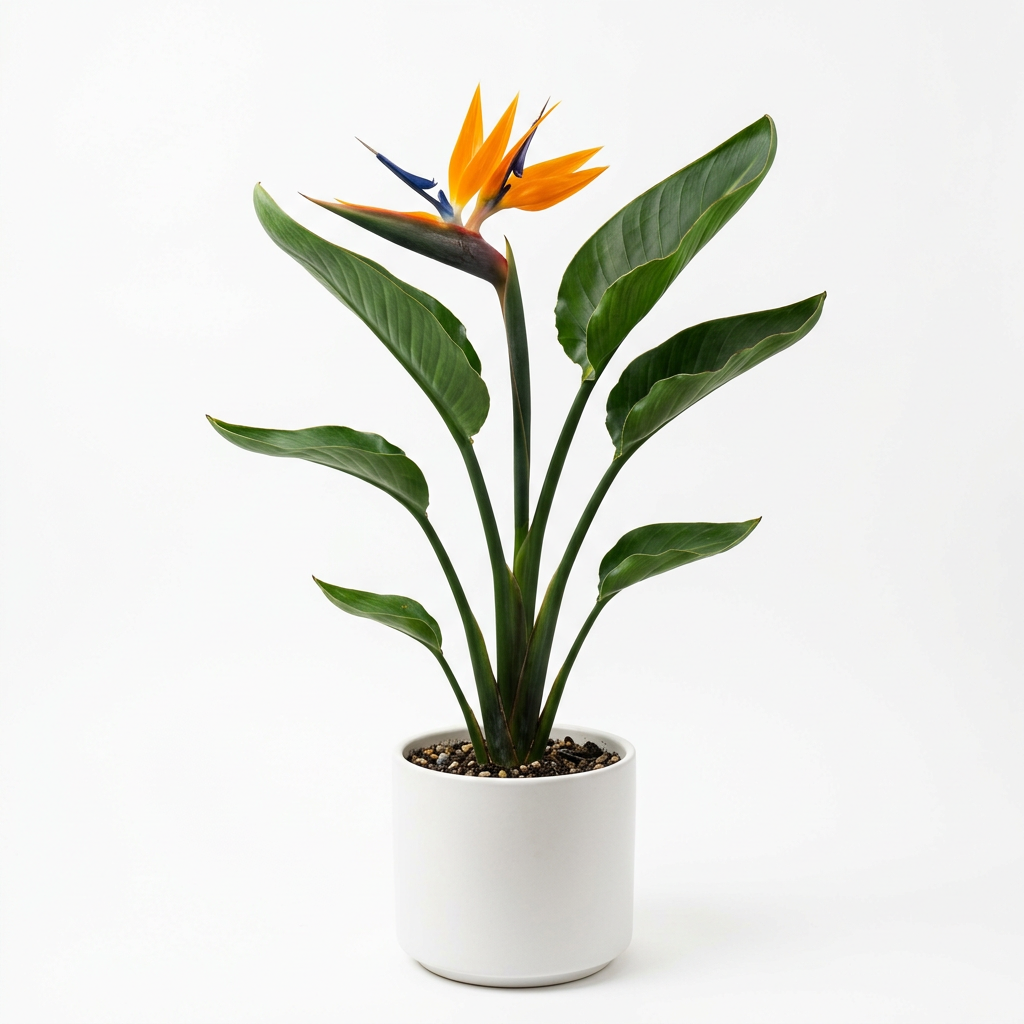
Bird of Paradise
ModerateStrelitzia reginae
Bird of paradise plants make a bold tropical statement with massive paddle-like leaves and — given enough light and patience — spectacular orange and blue blooms.
Light
Full sun to bright indirect light
Water
Every 1–2 weeks
Humidity
Average to high (50–70%)
Temperature
65–85°F (18–29°C)
Toxicity
Toxic to pets
Bird of Paradise is one of those plants that makes a room — full stop. With its enormous, paddle-shaped leaves on stiff, upright stems, Strelitzia reginae brings genuine tropical drama indoors or out. Given the right conditions (and a little patience), it will eventually reward you with those iconic orange and blue blooms that give it its name.
Quick Care Overview
| Care Factor | Requirement |
|---|---|
| Light | Full sun to bright indirect light |
| Water | Every 1–2 weeks |
| Humidity | Average to high (50–70%) |
| Temperature | 65–85°F (18–29°C) |
| Soil | Well-draining loamy mix |
| Fertilizer | Monthly during spring and summer |
| Toxicity | Toxic to pets |
Light Requirements
Bird of Paradise is a true sun lover — this is a plant that thrives on as much light as you can give it. Indoors, a south- or west-facing window is ideal. Outdoors, it’s happiest in a spot that gets direct sun for most of the day. Low light will keep it alive but not thriving, and without adequate brightness, flowering is essentially off the table.
- Low light: Growth slows significantly, leaves may become smaller and dull, and the plant will not bloom.
- Bright indirect light: Good for foliage growth; plants can be healthy and full but may still struggle to flower without some direct sun.
- Direct sun: Ideal — encourages the fastest growth, the largest leaves, and is essentially required for consistent blooming. Acclimate plants gradually to prevent leaf scorch if moving from lower light.
Watering
During the active growing season (spring through summer), water Bird of Paradise every 1–2 weeks, allowing the top inch or two of soil to dry out between waterings. It appreciates consistent moisture during this period but dislikes sitting in wet soil. In fall and winter, cut back significantly — once every 2–3 weeks is usually enough. Bird of Paradise is moderately drought tolerant once established, so erring on the side of slightly dry is safer than overwatering.
Water thoroughly until it drains from the bottom, then empty the saucer so the roots aren’t sitting in standing water.
Signs of overwatering: Yellow leaves (especially lower ones), soft or mushy stems at the base, soggy soil that stays wet for weeks, root rot.
Signs of underwatering: Leaves curling, drooping, or splitting along the edges; dry and very lightweight pot; crispy brown leaf tips.
Humidity and Temperature
Bird of Paradise thrives in average to high humidity — ideally 50–70%. Most homes with normal ambient humidity will be fine, though it appreciates a boost in very dry climates or during winter when indoor heating drops humidity levels. A humidifier nearby, a pebble tray with water, or grouping it with other plants will all help.
Temperature-wise, keep it between 65–85°F (18–29°C). It can tolerate brief dips toward 50°F (10°C) outdoors but is not frost-hardy — bring it inside before temperatures drop. Avoid placing it near cold drafts, air conditioning vents, or heating units, all of which cause stress and leaf damage.
Soil and Potting
Bird of Paradise does best in a rich, well-draining loamy mix. A good all-purpose potting soil amended with perlite (roughly a 2:1 ratio) works well. The goal is soil that holds some moisture but drains freely — soggy soil is the fastest route to root rot.
One key quirk of this plant: it actually prefers to be somewhat root-bound before it will flower. Avoid repotting too frequently. Move up only one pot size when roots are visibly crowding the container or circling the drainage holes — typically every 2–3 years for younger plants, and even less often once mature. Spring is the best time to repot.
Propagation
Bird of Paradise is propagated by division — it cannot be reliably grown from stem cuttings. Division works best in spring when the plant is beginning its active growth phase.
- Remove the plant from its pot and gently shake off excess soil to expose the root mass.
- Identify a section with at least 2–3 healthy stems and an intact root system attached.
- Use a clean, sharp knife or pruning saw to cut through the rhizome, separating the division cleanly from the parent plant.
- Let the cut surfaces air-dry for an hour or two, then dust with powdered sulfur or cinnamon to discourage rot (optional but helpful).
- Pot the division in fresh, well-draining mix and water lightly.
- Place in bright indirect light and expect a sulky period of 4–8 weeks as the plant adjusts — this is normal. Avoid overwatering during this time.
Fertilizing
Feed Bird of Paradise once a month during spring and summer with a balanced liquid fertilizer (such as 10-10-10 or 20-20-20) diluted to half strength. For plants you’re trying to encourage to bloom, a fertilizer with a slightly higher phosphorus middle number can help support flowering. Do not fertilize in fall and winter when growth slows — unused fertilizer salts accumulate in the soil and can burn roots.
Flush the soil thoroughly with plain water every 2–3 months to prevent salt buildup, especially if you’re using a liquid fertilizer regularly.
Common Problems
Yellow leaves: Most often caused by overwatering or poor drainage. Check that the soil is drying out appropriately between waterings and that the pot has drainage holes. Less commonly, yellowing on older lower leaves is simply natural aging.
Brown leaf tips or edges: Typically a sign of low humidity, inconsistent watering, or fluoride sensitivity. Use filtered or distilled water if tap water is heavily treated, and boost humidity if the air is very dry.
Leaf splitting: The large leaves split naturally along the veins — this is actually an evolutionary adaptation to reduce wind resistance outdoors, and it’s completely normal. Excessive splitting indoors can sometimes be caused by low humidity or temperature stress, but some splitting is expected and not a problem.
No blooms: The most common frustration with Bird of Paradise. Plants need to be at least 3–5 years old, receive 6+ hours of bright light (ideally with some direct sun), be slightly root-bound, and be well-fertilized during the growing season. If your plant is ticking all those boxes and still not blooming, be patient — sometimes it just takes time.
Scale or mealybugs: Look for sticky residue on leaves, white cottony clusters in leaf joints, or small brown bumps on stems. Treat with insecticidal soap, neem oil, or by dabbing individual bugs with a cotton swab dipped in rubbing alcohol. Repeat weekly until resolved.
Root rot: Caused by consistently wet soil. If roots are brown, mushy, and smell unpleasant, remove the plant from its pot, trim all rotten roots back to healthy tissue, and repot in fresh dry mix. Allow the plant to recover before resuming normal watering.
Is Bird of Paradise Toxic?
Yes — Bird of Paradise (Strelitzia reginae) is toxic to pets. If ingested by cats or dogs, it can cause nausea, vomiting, and drowsiness. The flowers and seeds are considered the most toxic parts of the plant. Keep it out of reach of curious pets, and contact your veterinarian if you suspect ingestion.
Once Bird of Paradise finds its light and settles in, it’s a remarkably rewarding plant — steadily putting out new growth, making a statement in any space, and (eventually) delivering those extraordinary blooms that make the wait completely worth it.