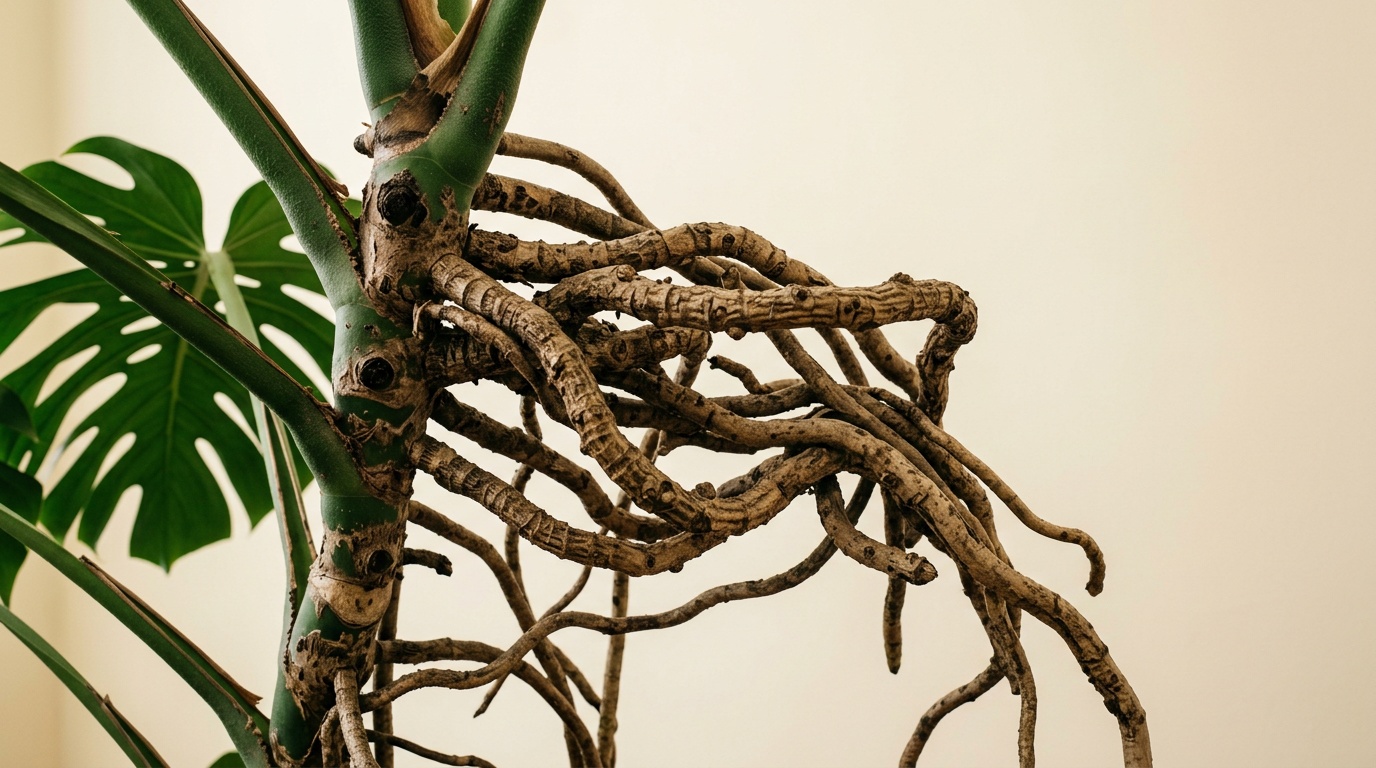
What To Do With Monstera Aerial Roots (Cut Them? Train Them? Leave Them?)
Quick answer
You can cut monstera aerial roots, leave them, or train them onto a moss pole or into the soil — none of these will hurt the plant. They're used for climbing and absorbing moisture. The only thing to avoid is wrapping them tightly, which can damage the root tissue.
Those long, brown, sometimes almost cord-like roots growing out of the side of your monstera — they catch people off guard the first time. A lot of folks assume something has gone wrong, or that the plant is getting too big for its pot, or that they need to do something about them right now. Most of the time, none of that is true. Aerial roots are a totally normal part of how a monstera grows, and you’ve got a few reasonable options for what to do with them. None of them are wrong, exactly — it mostly comes down to what works for your space and what you prefer to look at.
What Are Monstera Aerial Roots Actually Doing?
In the wild, monsteras are climbers. They start low on the forest floor and work their way up trees toward the light. The aerial roots are a big part of how they do that — they latch onto bark and other surfaces and help the plant hoist itself upward.
In your living room, there’s usually no tree trunk to grab onto, so the roots just… grow out into the air and sort of dangle there. But they’re still doing a little something useful even without a surface to attach to. They can absorb some moisture and trace nutrients from the air around them. It’s not the main way your monstera feeds itself — that’s still the roots in the soil — but it’s not nothing either.
So when you see those roots, the plant isn’t struggling. It’s just being a monstera.
Option 1: Leave Them Alone (Totally Fine)
This is honestly the easiest choice, and there’s nothing wrong with it. Aerial roots don’t harm the plant, they don’t mean anything is off, and they don’t require any action on your part. If they’re not bothering you, just let them do their thing.
Some people actually like the look. It gives the plant a kind of wild, tropical feel — which, fair enough, that’s exactly what it is.
The only time leaving them gets a little tricky is when they get really long and start wrapping around other plants, knocking things over, or getting in the way. At that point, you might want to do something with them. But there’s no timeline on that — it’s whenever it becomes an issue for you.
Option 2: Cut Them Off (Also Fine)
If you don’t like how they look, or one is growing in an inconvenient direction, you can cut it. This does not hurt the plant. I know that sounds like it should be more complicated, but it really isn’t.
Use clean scissors or pruning shears — clean meaning wiped down, not necessarily sterilized with a whole ritual, but you don’t want to drag dirt or bacteria from another plant onto a fresh cut. Clip the root as close to where it’s growing from (the node or stem) as you can, or cut it back to whatever length feels manageable.
The plant may grow a new aerial root from that spot eventually. Or it might not. Either way, you haven’t done any damage.
One thing I’d say: if you’re cutting a lot of them at once, just spread it out a little rather than removing every single one in one session. Not because it’ll harm the plant exactly, but it’s just a gentler approach overall.
Option 3: Train Them (The Most Beneficial Choice, If You Want to Put in the Effort)
This is where it gets a little more interesting. If you’re willing to give your monstera something to grab onto, it’ll reward you for it. Aerial roots that have a surface to attach to — a moss pole, a piece of bark, or even the soil — will anchor and start pulling in more moisture and nutrients. The plant can put that energy into producing larger leaves, and you’re likely to see more of that distinctive splitting and fenestration that people grow monsteras for in the first place.
There’s a whole separate conversation about why moss poles change how monsteras grow — if you want to go deeper on that, Why a Moss Pole Actually Changes How Your Monstera Grows (It’s Not Just Support) covers it well. But the short version is: giving aerial roots something to do is good for the plant.
If you’re using a moss pole, the goal is to gently guide the roots toward the pole and let them find their own grip. Wrapping sphagnum moss around the pole and keeping it lightly moist gives the roots something to absorb from and encourages them to attach. They won’t attach overnight — give it some time.
You can also tuck aerial roots directly into the potting soil. This works well and is much simpler than setting up a pole. Just bend the root gently toward the soil and press it in a bit. If the root is stiff and doesn’t want to cooperate without a fight, don’t force it — you could snap it, which is more damaging than just leaving it. If it bends easily, guide it in and let it settle.
What About Putting Aerial Roots in Water?
Some people set the aerial roots in a small container of water — like a little cup or vase next to the pot — and let them sit in there. It works. The roots will absorb the water, which is a small benefit. If you go this route, change the water every week or so to keep it from getting stagnant or growing algae. It’s more of a thing people do because they like the look of it, and that’s a perfectly valid reason.
It’s not going to transform how your plant grows the way a proper moss pole setup will, but it’s not harmful either.
The One Thing to Avoid: Wrapping or Banding Them Tightly
Most guides skip this part, but it’s worth saying. If you’re trying to tidy up aerial roots by wrapping them in a tight coil, securing them with a rubber band, or bundling them together, don’t. Aerial roots are living tissue. Constricting them can cut off circulation, cause them to rot or die back, and potentially create an entry point for disease where the dead root meets the stem.
If you want to keep things tidy, cut the roots you don’t want. If you want to train them, guide them gently and let them find their own way. But don’t try to manage them by squishing them into a tidy bundle — that’s the one approach that can actually cause problems.
A Quick Comparison of Your Options
| Option | Effect on Plant | Best For |
|---|---|---|
| Leave them | No change — totally neutral | Anyone who doesn’t mind the look |
| Cut them | No harm, slightly less the plant can absorb | Aesthetics, tidying up |
| Train to moss pole | Actively beneficial — better growth over time | People who want bigger leaves and more splits |
| Tuck into soil | Mildly beneficial — more anchoring and moisture | Easy middle ground, no extra equipment |
| Set in water | Minor benefit — some moisture absorption | People who like the visual, willing to change water regularly |
| Wrap tightly | Can damage root tissue | Don’t do this one |
Should You Do Anything Right Now?
Probably not, unless something is bothering you. If the aerial roots are just hanging there and not in anyone’s way, they’re fine. If one is growing toward your couch or knocking into another plant, deal with that one. If you’re interested in getting bigger leaves and more dramatic growth, setting up a moss pole is worth considering — but that’s a separate project and not an emergency.
If your monstera has aerial roots but you’re still figuring out the basics of caring for it, Monstera Care: What the Vague Guides Don’t Tell You is a good place to make sure you’ve got the fundamentals sorted first. Soil, pot size, watering, light — those things will do more for your plant than any decision about aerial roots.
Monsteras are pretty adaptable plants. They’ll grow aerial roots whether you want them to or not, and they’ll keep going whether you cut them, train them, or just let them hang. The main thing is not to panic when you see them. They’re not a symptom — they’re just the plant being itself.
Frequently asked questions
Should I cut off monstera aerial roots?
Yes, you can cut them off if they're bothering you or getting in the way. It won't hurt the plant. Use clean scissors or pruning shears and cut close to the node. The plant may grow new ones over time.
What are the air roots on my monstera for?
Aerial roots help your monstera do two things: climb toward light the way it would in the wild, and absorb some moisture and nutrients from the air and surrounding environment. They're not a sign something is wrong — they're the plant doing exactly what it's supposed to do.
Can I put monstera aerial roots in water?
You can set them in a small vessel of water and they'll absorb it, which some people do. It works fine as long as you keep the water clean and change it regularly. It won't dramatically change how your monstera grows, but it's a reasonable option if you like the look.
Can I tuck monstera aerial roots into the soil?
Yes, and it actually gives the plant something useful — moisture and a bit of extra anchoring. Just guide them gently into the pot. Don't force them if they're stiff, and don't coil or band them tightly, which can damage the root.