I Added Biochar to My Potting Mix. Six Months Later, Here's What I Think
Quick answer
Biochar can improve drainage and aeration in potting mix and may support beneficial soil microbes over time. After six months of side-by-side testing, I noticed slightly better drainage and anecdotally faster root establishment in biochar pots. It's a worthwhile addition, but not a miracle ingredient.
About six months ago I started hearing more and more about biochar showing up in people’s potting mixes. I kept seeing it mentioned in plant groups, on YouTube, in the comments of repotting videos. So I decided to actually try it — not just throw it into all my pots and hope for the best, but test it in a way where I could actually notice a difference.
I repotted a bunch of plants in the spring. Half got my usual custom mix. The other half got the same mix with biochar added. Same plant types, same pot sizes, same care routine, same spot in my house. Then I just watched.
Here’s what six months looks like.
What Biochar Actually Is (And Why It’s Different From Regular Charcoal)
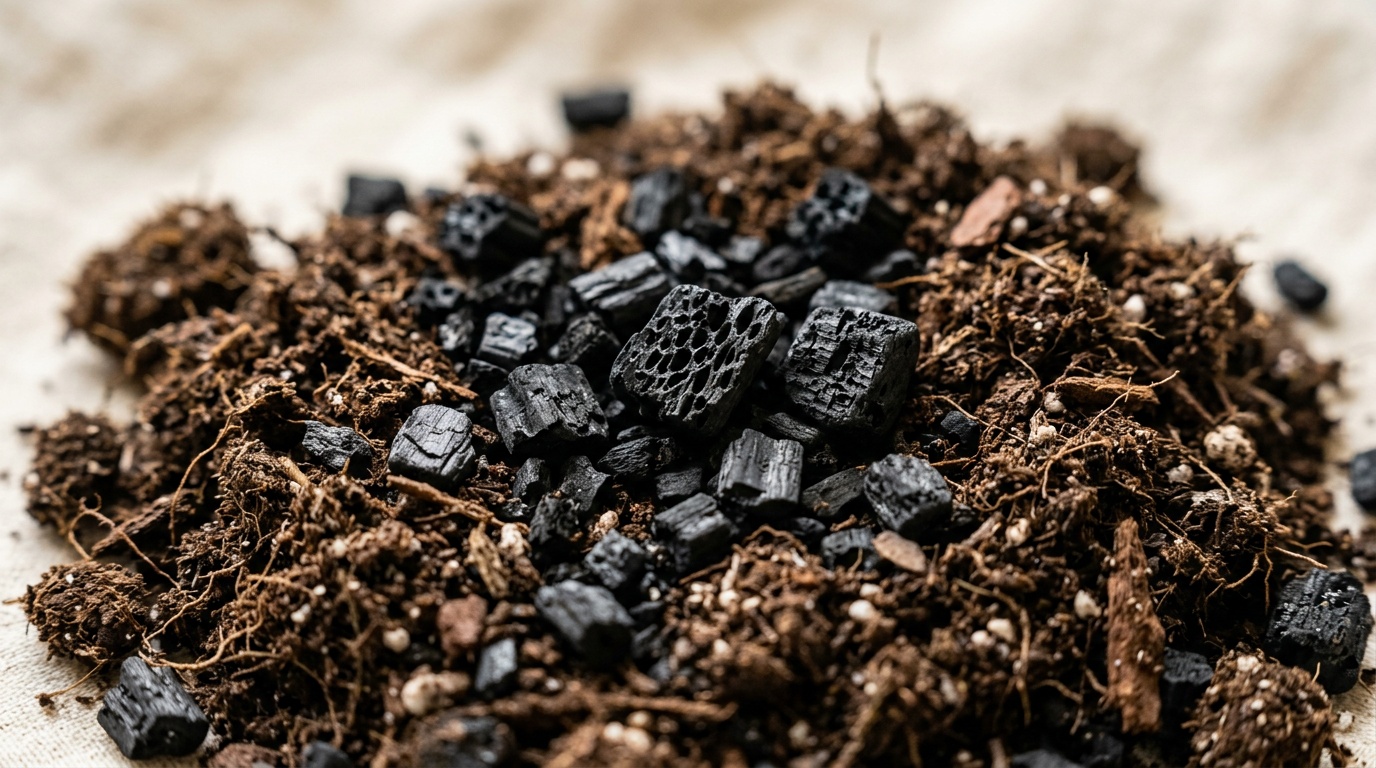
Before I get into what I noticed, it helps to know what this stuff even is. Biochar is charcoal — but it’s made by burning organic material like wood or plant matter at really high temperatures with very little oxygen. That process, called pyrolysis, creates something incredibly porous at a microscopic level.
All those tiny pores are the whole point. They give beneficial soil microbes somewhere to live and anchor themselves. They hold onto water and nutrients, but without making the soil waterlogged. And they improve aeration, which is huge for roots.
It’s worth noting that biochar is not the same thing as the activated charcoal you might toss into a terrarium. Activated charcoal is processed specifically for filtration. Biochar — particularly horticultural biochar — is designed to work as a soil amendment. Different product, different purpose, even if they look similar in the bag.
I used Char Bliss Organic Biochar (8qt) for this experiment, which is one of the more widely available horticultural options. It comes in a reasonable size for home use and the particle size felt right for mixing.
How I Set Up the Experiment
I wasn’t running a lab here. I’m just someone who repots a lot of plants and pays attention. But I did try to keep things as consistent as I could.
The plants I used: I stuck mostly to pothos and philodendrons because I had a lot of them that needed to be split up anyway. Similar size, similar root development, similar care needs.
The base mix I used for both groups:
- 4 parts coco husk fiber
- 4 parts sphagnum moss
- 1 part orchid bark
- ¼ part worm castings
The biochar group got an extra ¼ part of horticultural biochar mixed in. That’s it. Everything else stayed the same — same pots, same locations, same mild fertilizer added to the water each time I watered, same watering frequency based on what my soil moisture meter was telling me.
The control group got the exact same mix without the biochar.
I checked in on both groups roughly every week, just looking at overall plant health, how fast the soil was drying, and what the roots looked like during a mid-point check around the three-month mark.
If you’re curious about the base mix itself, I talked more about why I moved away from store-bought soil over in Why Store-Bought Potting Mix Is Slowly Killing Your Tropicals — that piece goes into why pre-bagged mixes tend to be so dense and why that causes problems over time.
What I Actually Noticed After Six Months
Let me be straightforward: the differences were not dramatic. If you’re hoping biochar is going to transform your plants overnight, it won’t. But there were some consistent things I noticed.
Drainage felt slightly better in the biochar pots. When I watered, the water moved through the biochar mix a little more freely. Not a huge difference, but noticeable. The soil also seemed to dry a bit more evenly rather than staying wet at the bottom while the top dried out fast. That even drying is something I really care about because uneven moisture is such a common cause of root stress.
Root establishment looked faster at the three-month check. When I peeked at the roots around month three, the biochar pots had more visible root spread. Now, I want to be careful here — this is anecdotal. Different cuttings, even from the same plant, can establish at different rates. But across most of the pairs I was comparing, the biochar group was ahead. Slightly, but consistently.
Overall plant health looked about the same. Leaf color, new growth rate, general vigor — I didn’t see a meaningful difference there. Both groups were doing fine. If biochar is doing something beneficial for long-term plant health through microbe activity, it’s not showing up visually in a six-month window. That’s honest.
Moisture retention claims? Hard to verify at home. One of the things biochar is supposed to do is hold onto nutrients and release them gradually. I believe this is probably happening at a microscopic level, but there’s no way for me to measure it in my living room. I fertilize lightly every time I water, so it’s also possible I’m just making that point moot regardless.
Here’s a simple comparison of what I observed:
| What I Was Watching | Control Group (No Biochar) | Biochar Group |
|---|---|---|
| Drainage speed | Good | Slightly better |
| Soil drying pattern | Uneven at times | More even |
| Root establishment (3 months) | Normal | Slightly ahead |
| Leaf growth and color | Healthy | Healthy |
| Nutrient retention | Can’t measure | Can’t measure |
Biochar vs. Perlite: Do You Need Both?
I get asked about this a lot. Both biochar and perlite improve aeration and drainage, so are they doing the same job?
Not exactly. Perlite is great at creating air pockets and speeding up drainage — it’s lightweight volcanic glass and it does its job physically. Biochar does some of that too, but the difference is the microbial angle. Perlite doesn’t really do anything for soil biology. Biochar, with all those tiny pores, gives beneficial microbes a place to colonize and persist.
So if you’re building a mix from scratch, I don’t think you have to choose. I use both. The What Perlite Actually Does (And Why I Add It to Almost Everything) post goes into more detail on what perlite specifically brings to a mix — worth reading if you’re still figuring out what you actually need.
How Much Biochar Should You Add?
You don’t need a lot. I used roughly a quarter part for every four parts of my base mix. Some people go higher, but I wanted to start conservative so I could actually see what it was doing without completely changing my mix.
If you’re working with a recipe you already like, I’d suggest just swapping out a small portion of your current mix volume for biochar and seeing how it feels. Add too much and you might end up with a mix that drains too fast for plants that like to stay slightly moist.
Also — biochar is pretty lightweight and can be dusty out of the bag. I mix it in outside or near an open window. Not a big deal, just something to be aware of.
If you’re working with a mix that includes Halatool Natural Sphagnum Moss (9oz) as a base layer, biochar works really well alongside it. The moss holds moisture while the biochar helps distribute it and keeps things from getting too compacted over time.
What I’m Still Not Sure About
I want to be upfront about the limits of what I can tell you from a home experiment.
The nutrient retention claims — that biochar holds onto fertilizer and releases it slowly, making your feeding more efficient — are probably true based on the science I’ve read. But I can’t confirm that from watching my plants for six months. It’s just not something you can see.
The microbe colonization story is also compelling, but again, I’m not running soil biology tests. What I can say is that nothing went wrong. No increased mold, no weird soil behavior. The microbial environment seemed at least as healthy as my control pots, probably better.
Long-term, I’m curious whether the benefit compounds. A lot of people who use biochar say the effects get more noticeable over a year or two as the microbial community builds up. That makes sense to me. Six months might just be the beginning of what biochar does.
My Honest Verdict
Biochar is worth adding to your potting mix. It’s not going to rescue a plant that’s struggling because of overwatering or bad light — nothing in the soil is going to fix that. But as one piece of a well-thought-out mix, it seems to do some quiet, useful work.
What I noticed most was slightly better drainage behavior and what looked like faster root establishment. Those are real benefits. The longer-term claims about nutrient cycling and soil biology are probably real too, but I can’t personally verify them yet.
What I’d say is this: if you’re already building your own mix and thinking about what to add, biochar is a reasonable choice. It’s not expensive, it’s easy to work with, and from what I’ve seen so far, it’s earning its spot in my recipe. I’ll keep it in the mix going forward.
If you’re brand new to building your own potting mix and haven’t gotten there yet, start with the basics first — coco fiber, moss, bark, some drainage amendment. Get comfortable with that, then experiment with things like biochar once you have a baseline to compare against. That way you’ll actually be able to tell what’s making a difference.
And honestly? That’s the best part of keeping plants. You can just try things, pay attention, and learn what works for your space and your plants. No one gets it perfect from the start.
Frequently asked questions
Does biochar help houseplants?
It can, yes. Biochar improves aeration and drainage in potting mix and creates a porous environment where beneficial microbes can settle in. In my six-month test, plants in biochar mixes showed slightly better drainage and what looked like faster root establishment — though the long-term nutrient retention benefits are harder to measure at home.
How do I use biochar in potting mix?
Mix biochar into your potting blend before repotting — I use roughly a quarter part biochar for every four parts of my base mix. You don't need a lot. Think of it as one piece of a well-balanced mix rather than the whole solution.
Is biochar the same as activated charcoal for plants?
They're similar but not the same. Both are forms of charcoal, but activated charcoal is processed differently and is more commonly used for filtration. Biochar is made specifically from organic material like wood, burned at high heat with limited oxygen. For potting mix purposes, horticultural biochar is what you want.
Is biochar worth it for indoor plants?
In my experience, yes — with realistic expectations. It's not going to save a struggling plant or replace good watering habits, but as part of a well-built potting mix, it seems to do some quiet, useful work over time.